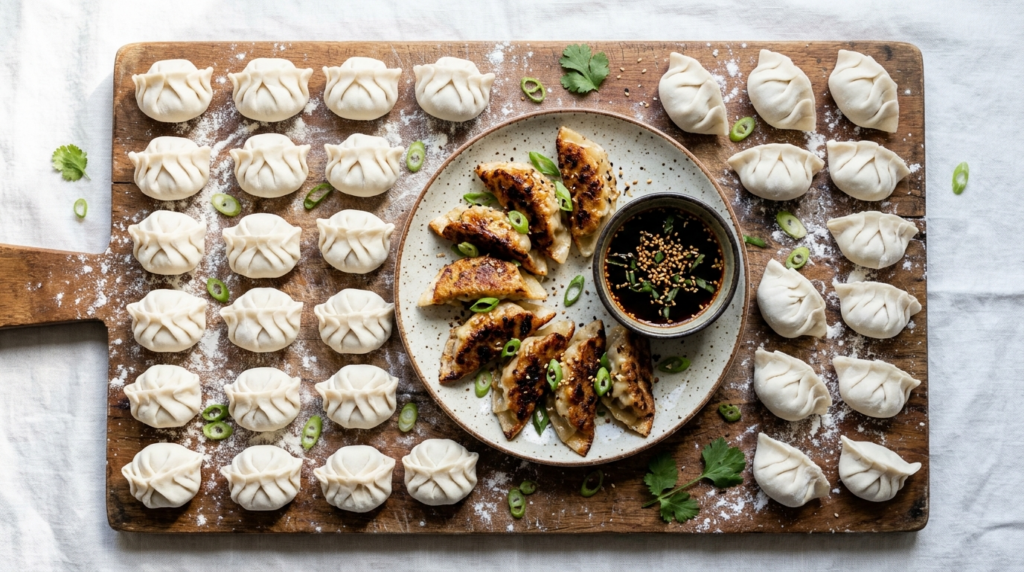
Cabbage mushroom dumplings are a deeply satisfying, plant-forward dish that works as an appetizer, side, or main course. The filling combines the mild sweetness of napa cabbage with the earthy depth of shiitake and cremini mushrooms, seasoned with soy sauce, sesame oil, ginger, and garlic. The result is a juicy, fragrant filling that holds its own against any meat-based version.
This recipe walks you through making the dough from scratch, preparing and salting the cabbage to draw out excess moisture, building a balanced filling, and folding the dumplings into a classic half-moon pleat. You will also find clear instructions for all three common cooking methods: pan-fried potsticker style, fully steamed, or boiled. Once you have the technique down, cabbage mushroom dumplings are genuinely achievable on a weeknight, and they freeze beautifully for future meals.
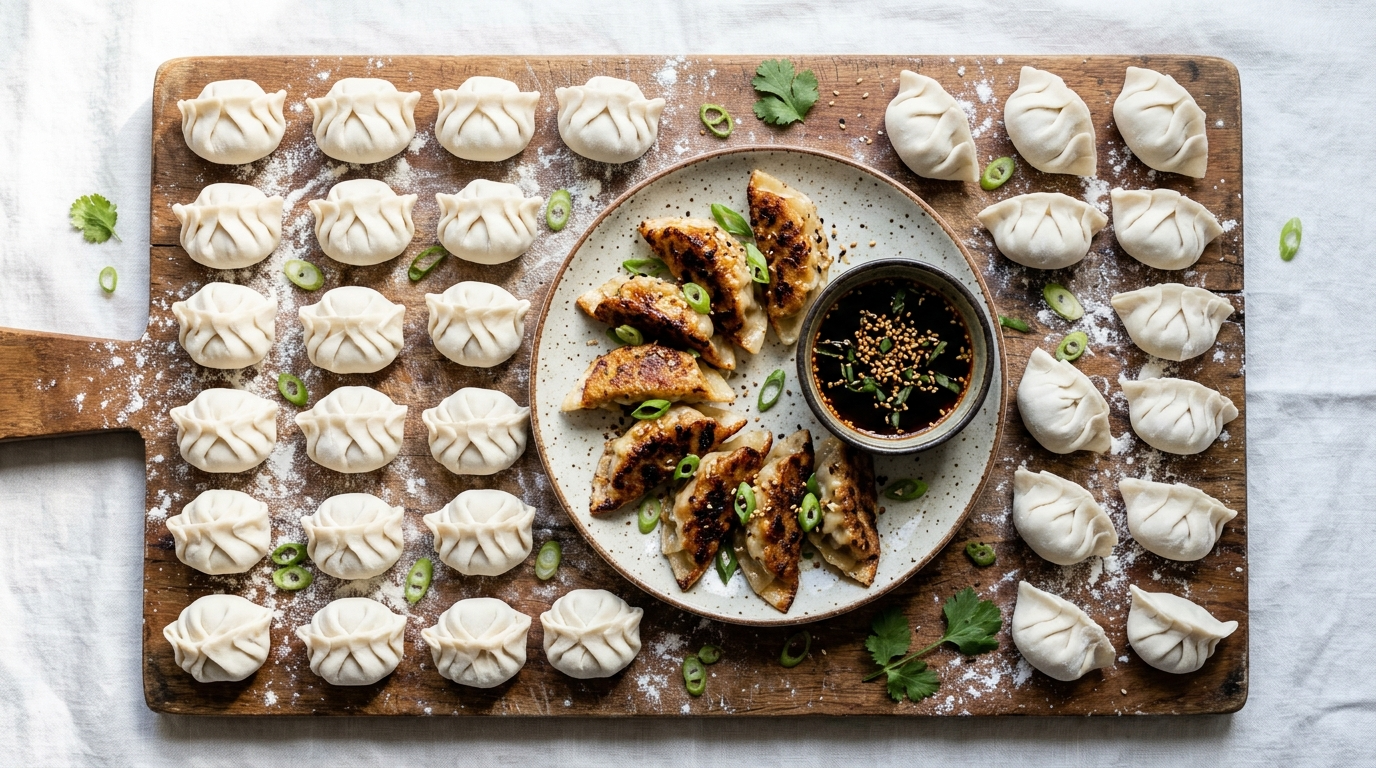
Cabbage Mushroom Dumplings Recipe – Juicy Veggie Filling, Step-by-Step
These cabbage mushroom dumplings feature a savory, umami-rich filling of napa cabbage and mixed mushrooms wrapped in a tender homemade dough. Pan-fry, steam, or boil them for a satisfying meal any night of the week.
Prep: 60 minutes | Cook: 25 minutes | Servings: 4
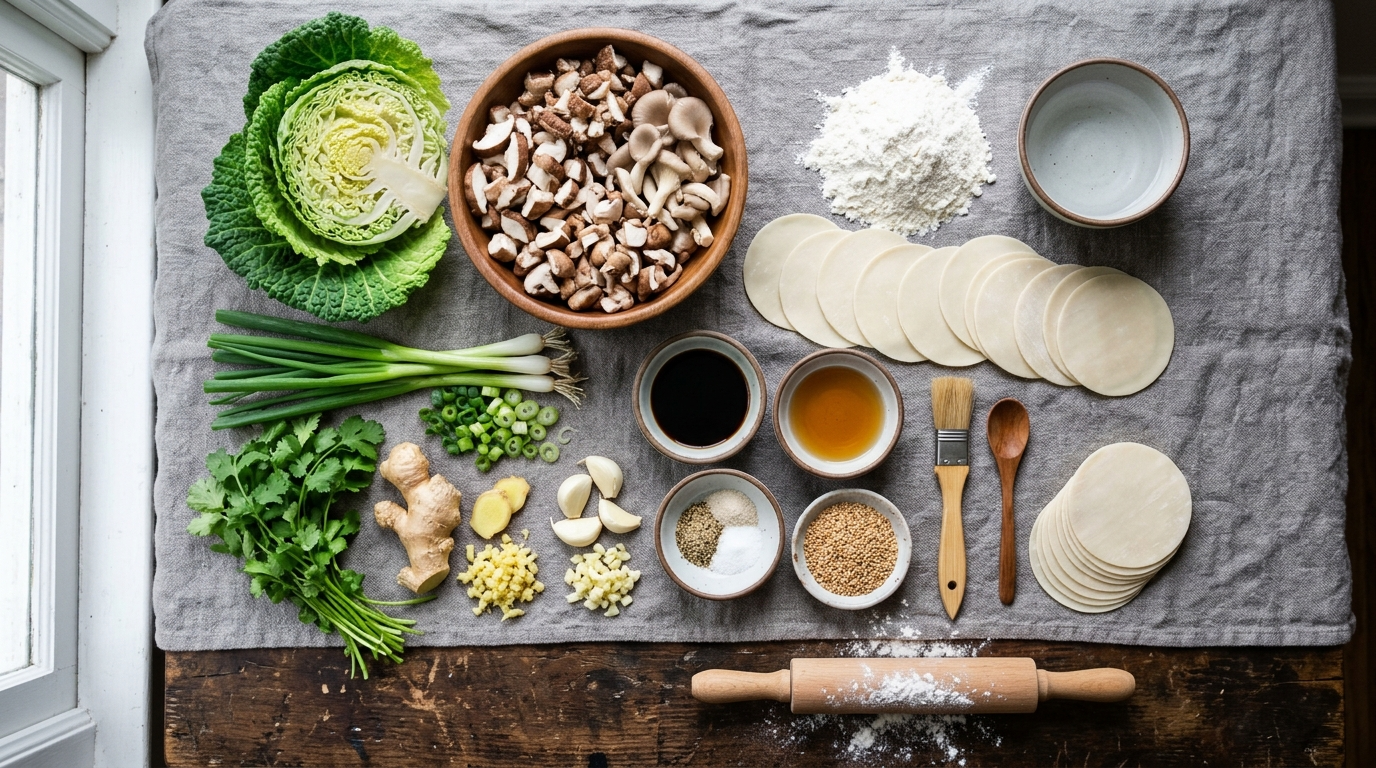
Ingredients
- 2 cups all-purpose flour About 240 grams; plus extra for dusting
- 0.75 cup just-boiled water Water that has just come off the boil, not actively boiling; add gradually
- 0.5 teaspoon kosher salt For the dough
- 3 cups napa cabbage Finely shredded; about one-quarter of a small head
- 1 teaspoon kosher salt For drawing moisture from the cabbage; rinsed off before use
- 8 ounces shiitake mushrooms Stems removed, caps finely chopped
- 4 ounces cremini mushrooms Finely chopped
- 3 cloves garlic Minced
- 1 tablespoon fresh ginger Peeled and finely grated
- 3 stalks green onions Thinly sliced, white and green parts
- 2 tablespoons soy sauce Use tamari for gluten-free version
- 1 tablespoon toasted sesame oil
- 1 teaspoon rice vinegar
- 0.5 teaspoon white pepper
- 1 tablespoon neutral cooking oil Such as canola or vegetable oil; for cooking mushrooms
- 2 tablespoons neutral cooking oil For pan-frying dumplings; divided between batches
- 0.33 cup water Per batch for the steam step when pan-frying
- 3 tablespoons soy sauce For dipping sauce
- 1 tablespoon rice vinegar For dipping sauce
- 1 teaspoon toasted sesame oil For dipping sauce
- 0.5 teaspoon chili oil or chili flakes Optional; for dipping sauce
Instructions
- Make the dough: Combine 2 cups (240 g) all-purpose flour and 0.5 teaspoon kosher salt in a large mixing bowl. Stir to distribute the salt. Add 0.75 cup just-boiled water in a slow, steady stream while stirring with a fork or chopsticks. The water should be very hot but no longer actively boiling. Mix until shaggy, then turn the dough out onto a lightly floured surface.
- Knead the dough for 8 to 10 minutes until smooth, supple, and not sticky, adding flour one teaspoon at a time only if the dough is tacky. Form it into a ball, place it back in the bowl, and cover tightly with a damp towel or plastic wrap. Rest at room temperature for 30 minutes. This rest is essential for the gluten to relax and makes rolling much easier.
- Salt the cabbage: Place the finely shredded napa cabbage in a colander set over a bowl or the sink. Toss with 1 teaspoon kosher salt and let sit for 15 minutes. The salt draws out moisture. After 15 minutes, gather the cabbage in a clean kitchen towel or several layers of paper towel and squeeze firmly to extract as much liquid as possible. The cabbage should reduce significantly in volume. Discard the liquid.
- Cook the mushrooms: Heat 1 tablespoon neutral oil in a large skillet over medium-high heat. Add the chopped shiitake and cremini mushrooms in a single layer. Do not stir for the first 2 to 3 minutes to allow browning. Stir and continue cooking for another 3 to 4 minutes until the mushrooms are deeply browned and all released moisture has evaporated. Transfer to a large bowl and let cool for 10 minutes before adding remaining filling ingredients.
- Make the filling: To the cooled mushrooms, add the drained cabbage, minced garlic, grated ginger, sliced green onions, 2 tablespoons soy sauce, 1 tablespoon sesame oil, 1 teaspoon rice vinegar, and 0.5 teaspoon white pepper. Mix thoroughly. Taste and adjust seasoning. The filling should be well-seasoned and cohesive. If it seems wet, let it sit in the bowl for 5 minutes then press any pooled liquid out with a spoon.
- Make the dipping sauce: Stir together 3 tablespoons soy sauce, 1 tablespoon rice vinegar, 1 teaspoon sesame oil, and chili oil or flakes if using. Set aside.
- Roll the wrappers: Lightly flour a clean work surface. Divide the rested dough in half. Roll one half into a rope about 1 inch in diameter and cut into pieces approximately the size of a large marble, about 12 to 14 pieces per rope (24 to 28 total). Keep the unworked pieces under the damp towel to prevent drying. Working one at a time, flatten each piece into a small disc with your palm, then use a rolling pin to roll into a circle 3 to 3.5 inches in diameter and about 1/16 inch thick. The edges should be slightly thinner than the center.
- Fill and fold: Place one wrapper flat on your palm. Spoon 1 heaping teaspoon of filling (about 10 to 12 grams) into the center. Do not overfill or the wrapper will tear. Dip your finger or a pastry brush in water and run it around the entire edge of the wrapper. Fold the wrapper in half over the filling to form a half-moon, pressing the center point together first. Working from the center toward one end, make 3 to 4 small pleats along one side of the dough, pressing each pleat firmly against the flat back side to seal. Repeat on the other side. Press firmly along the entire seam to ensure it is fully sealed with no air pockets. Place finished dumplings on a lightly floured baking sheet. Do not let them touch or they will stick.
- Continue filling and folding all dumplings. Keep finished dumplings covered with a damp towel while you work. You should have approximately 24 to 28 dumplings total.
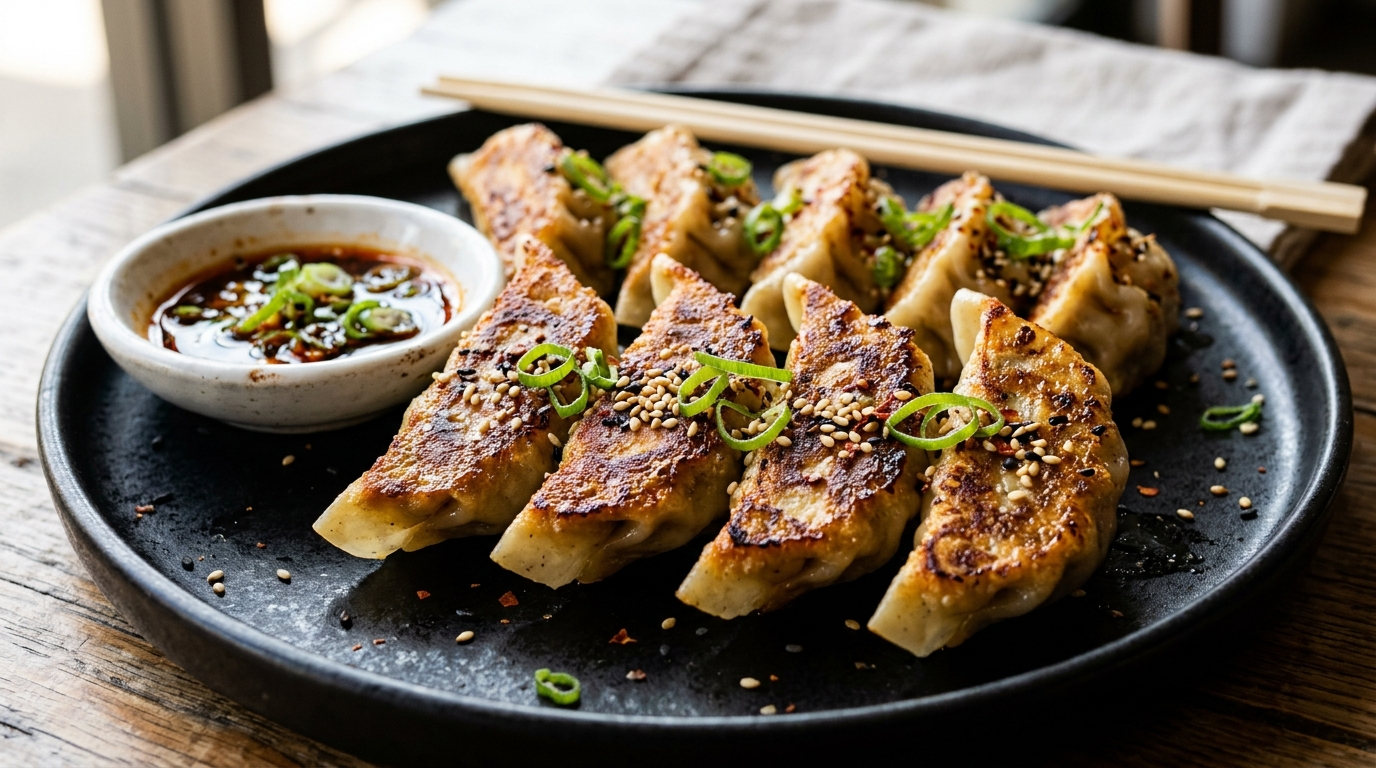
- Pan-fry method (potsticker style): Heat 1 tablespoon neutral oil in a large non-stick or cast iron skillet over medium-high heat. Arrange dumplings flat side down in a single layer without crowding; work in batches of 10 to 12. Cook undisturbed for 2 to 3 minutes until the bottoms are golden brown.
- Carefully add 0.33 cup water to the hot skillet (it will spatter). Immediately cover with a tight-fitting lid. Reduce heat to medium. Steam for 5 to 6 minutes until all the water has evaporated and the wrappers look translucent and cooked through. Remove the lid and cook for 1 more minute to re-crisp the bottoms. Verify that the filling has reached an internal temperature of 165 F with an instant-read thermometer. Transfer to a serving plate and repeat with remaining dumplings.
- Boiling method (alternative): Bring a large pot of water to a full rolling boil. Add dumplings in batches of 10 to 12 and stir gently to prevent sticking. Cook for 6 to 8 minutes, until the wrappers are tender and the filling reaches 165 F. Remove with a slotted spoon and serve immediately.
- Steaming method (alternative): Line a steamer basket with parchment paper or cabbage leaves and lightly oil the surface. Arrange dumplings with space between each. Steam over vigorously boiling water for 8 to 10 minutes until wrappers are cooked through and filling reaches 165 F. Serve immediately with dipping sauce.
- Serve immediately with dipping sauce on the side. Dumplings are best eaten right after cooking when textures are at their peak.
- Food safety for leftovers: Transfer any cooked leftover dumplings directly into shallow airtight containers and refrigerate within 2 hours of cooking, at 40 F or below. Use within 3 to 4 days. Reheat to an internal temperature of 165 F before eating. To freeze uncooked dumplings, arrange them in a single layer on a floured baking sheet and freeze until solid, about 2 hours, then transfer to freezer bags. Cook from frozen, adding 2 to 3 extra minutes to whichever cooking method you use.
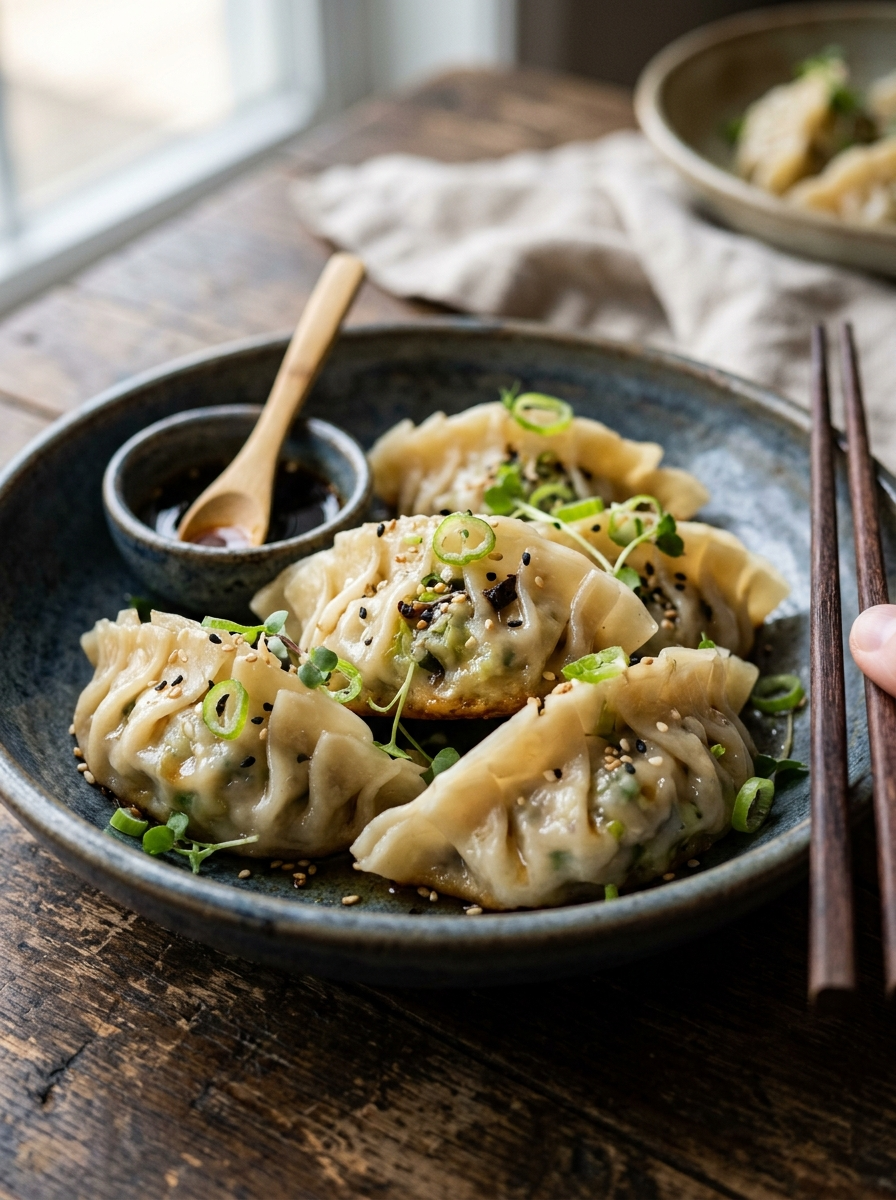
Dumplings are one of the most widespread food forms in the world, appearing across Chinese, Japanese, Korean, Eastern European, and Central Asian cuisines in various shapes and fillings. In Chinese cooking, the style most closely resembling this recipe traces back to the jiaozi, which has been documented in Chinese culinary texts for over a thousand years. Cabbage has long been a staple dumpling filling because it is affordable, widely available, and releases moisture during cooking that keeps the filling tender. Mushrooms became a common addition both for their umami flavor and as a meat substitute during Buddhist vegetarian cooking traditions in China and Japan. The potsticker technique—pan-frying dumplings and then adding water to steam them in the same pan—is associated with northern Chinese cooking and became widely popular across East Asia and globally through the twentieth century.
Practical Tips
- Squeezing every bit of liquid from the salted cabbage is the single most important step for a cohesive, non-soggy filling. Do not skip it.
- Let the cooked mushrooms cool before mixing the filling. Adding hot mushrooms to the other ingredients can make the garlic taste harsh.
- Roll wrappers slightly thinner at the edges than the center. The pleated seam has multiple layers, so thinner edges prevent a doughy, undercooked seam.
- If your dough springs back stubbornly while rolling, cover and rest it for another 10 minutes. Under-rested gluten resists stretching.
- Keep a small bowl of water at your work station while folding. Dry seams will not hold and dumplings will burst during cooking.
- To test your pan-frying timing, pick up one dumpling carefully after the steam step and check the bottom. It should be a deep amber gold, not pale.
- Use a large enough pan. Crowding causes steaming rather than browning on the flat side and makes it harder to add water safely.
- If you do not have a lid for your skillet, a large baking sheet placed over the pan works as a substitute lid for the steam step.
- For perfectly uniform dumplings, use a kitchen scale to portion filling at about 10 to 12 grams each.
- Frozen uncooked dumplings can go directly from the freezer into a hot oiled pan without thawing. Add 2 to 3 extra minutes to both the browning and steaming steps.
Large mixing bowl: Mixing dough and filling
Small bowl: Resting dough and mixing dipping sauce
Rolling pin: Rolling dough wrappers thin and even
Round cookie cutter or drinking glass (3 to 3.5 inches diameter): Cutting uniform dough circles
Chef's knife and cutting board: Finely chopping cabbage and mushrooms
Fine mesh strainer or colander: Draining salted cabbage
Large non-stick or cast iron skillet with lid: Pan-frying and steaming dumplings
Medium saucepan: Boiling dumplings if using that method
Steamer basket (optional): Fully steaming dumplings if preferred
Pastry brush or small spoon: Wetting dough edges to seal dumplings
Kitchen scale: Accurate flour measurement for consistent dough
Instant-read thermometer: Verifying filling reaches 165 F internal temperature
Vegan Version: This recipe is already plant-based if you use a vegan-certified soy sauce. No substitutions are required. Confirm your soy sauce brand does not contain anchovies or other animal-based additives.
Gluten-Free Wrappers: Substitute a 1-to-1 gluten-free flour blend formulated for pasta or dumpling dough. Results vary by brand. The dough will be more delicate and may require slightly more water. Use tamari instead of regular soy sauce in the filling and dipping sauce.
Tofu and Cabbage Mushroom Dumplings: Press 4 ounces of firm tofu between paper towels for 20 minutes to remove moisture, then crumble finely and add to the filling along with the mushrooms. The tofu adds protein and a slightly different texture to the filling.
Spicy Sichuan Style: Add 1 tablespoon of doubanjiang (spicy broad bean paste) and 0.5 teaspoon of Sichuan peppercorn powder to the filling. Serve with a dipping sauce made with chili crisp, soy sauce, black vinegar, and minced raw garlic.
Korean-Inspired Mandu Style: Add 1 cup of drained and squeezed firm tofu and 1 cup of blanched, drained, and squeezed glass noodles (dangmyeon) cut into small pieces to the filling. Season with garlic, sesame oil, soy sauce, and a pinch of sugar. Shape into a half-moon and pinch the ends together to form the classic mandu shape.
Store-Bought Wrapper Shortcut: Round gyoza or potsticker wrappers sold refrigerated at Asian grocery stores can substitute for homemade dough. Keep them covered with a damp towel while working to prevent drying. The texture will be slightly chewier and thinner than homemade.
Why do my dumplings burst open during cooking?
The most common causes are overfilling, inadequate sealing, or wet filling. Use only 1 heaping teaspoon of filling per wrapper and make sure the edges are sealed firmly with no air pockets trapped inside. Squeeze the cabbage thoroughly to prevent excess moisture from weakening the dough seal during cooking.
Can I make the dough and filling ahead of time?
Yes. The filling can be made up to 24 hours ahead and stored in an airtight container in the refrigerator at 40 F or below. The dough can be made up to 4 hours ahead, wrapped tightly in plastic, and kept at room temperature; for longer storage, refrigerate it and let it come to room temperature for 30 minutes before rolling. Assembled uncooked dumplings should be cooked or frozen within a few hours of assembly.
How do I store and reheat cooked dumplings?
Transfer cooked dumplings to shallow airtight containers and refrigerate within 2 hours of cooking at 40 F or below. Use within 3 to 4 days. Reheat in a lightly oiled non-stick pan over medium heat with a splash of water and a lid for 3 to 4 minutes, or until they reach an internal temperature of 165 F. You can also reheat by steaming or boiling, ensuring they reach 165 F throughout.
What is the best way to freeze dumplings?
Freeze dumplings uncooked for best results. Arrange them in a single layer on a lightly floured baking sheet, not touching, and freeze until solid, about 2 hours. Transfer to zip-top freezer bags, press out excess air, label with the date, and freeze for up to 3 months. Cook directly from frozen without thawing, adding 2 to 3 extra minutes to your chosen cooking method.
Can I use pre-shredded coleslaw mix instead of fresh napa cabbage?
Pre-shredded green cabbage coleslaw mix can work in a pinch, but the shreds are coarser than finely shredded napa cabbage. Chop the shreds more finely before salting and squeezing. Green cabbage is tougher than napa and may result in a slightly denser filling texture. Salt and drain it the same way.
My dumpling bottoms are sticking and tearing. What went wrong?
This usually means the pan is not non-stick enough, was not hot enough when dumplings were added, or the oil was insufficient. Use a well-seasoned cast iron or quality non-stick pan, make sure the oil shimmers before adding dumplings, and do not move them for the first 2 to 3 minutes while the crust forms. If a dumpling does stick, use a thin silicone spatula and gently work around the edges before lifting.
Do I need to use both shiitake and cremini mushrooms?
No, you can use all of one type if preferred. Shiitake mushrooms provide pronounced umami flavor and a slightly chewier texture. Cremini mushrooms are milder and cook down to a softer consistency. Using both provides a balance of flavor depth and texture. You could also use oyster mushrooms or king oyster mushrooms for a different character.