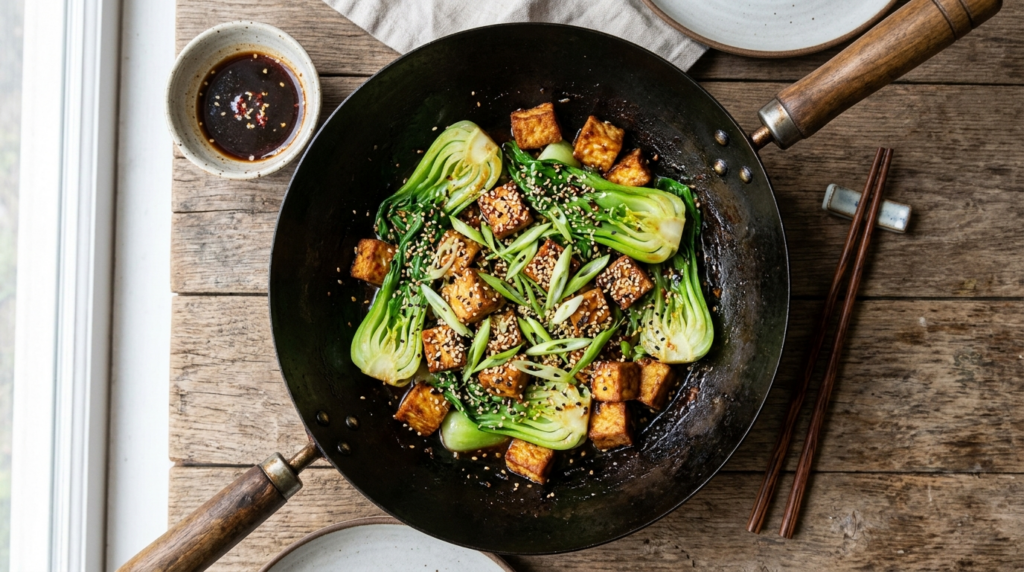
A good bok choy tofu stir fry checks all the boxes for a weeknight dinner: it comes together quickly, uses ingredients that are easy to keep on hand, and delivers genuine depth of flavor without requiring a complicated technique. The key is managing two elements well — getting the tofu genuinely crispy before the sauce goes in, and cooking the bok choy just long enough to soften the stems while keeping the leaves bright and slightly wilted rather than soggy.
This recipe uses extra-firm tofu pressed dry and seared in a hot pan, baby bok choy halved so it cooks evenly, and a sauce built from toasted sesame oil, soy sauce, rice vinegar, garlic, and ginger. Cornstarch thickens the sauce just enough to coat everything without turning it gluey. The whole dish comes together in a single large skillet or wok, making cleanup simple. Serve it over steamed jasmine rice, brown rice, or soba noodles for a complete meal.
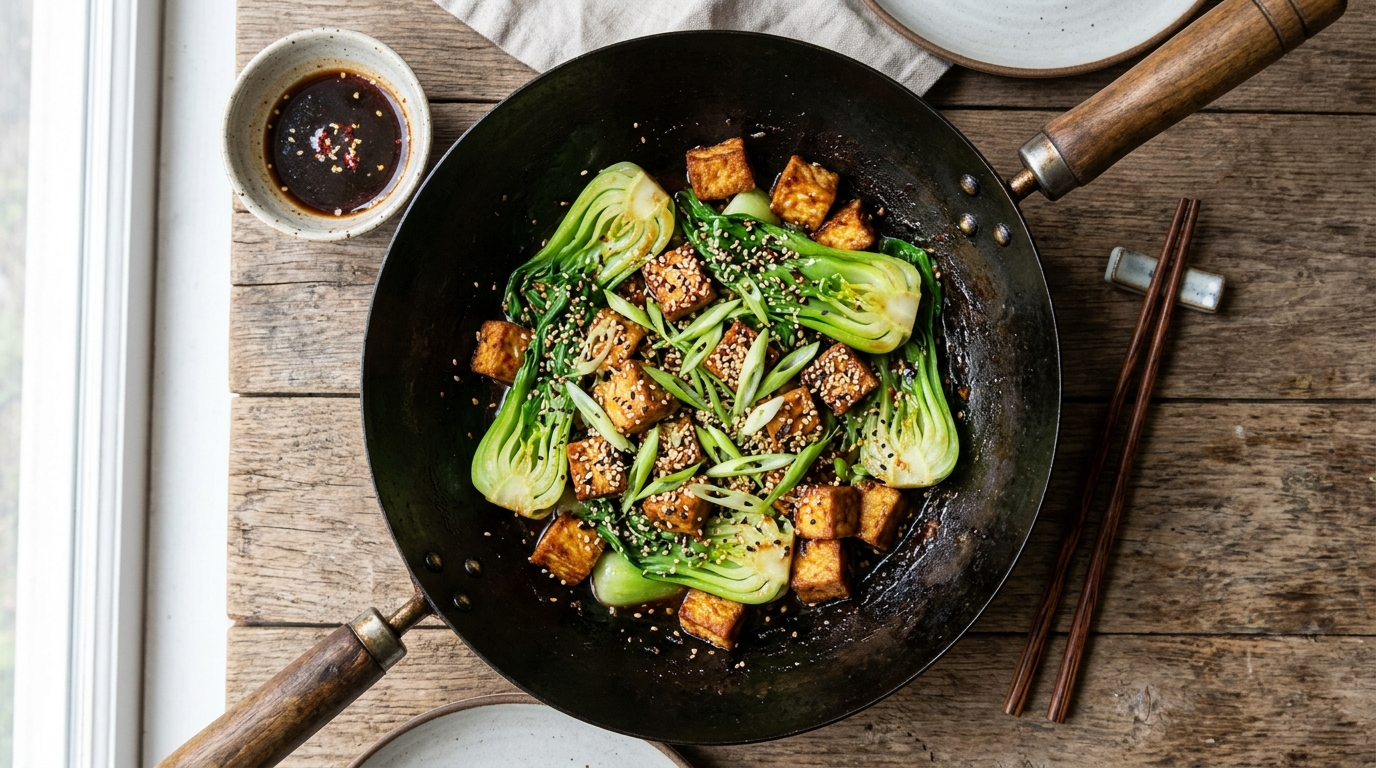
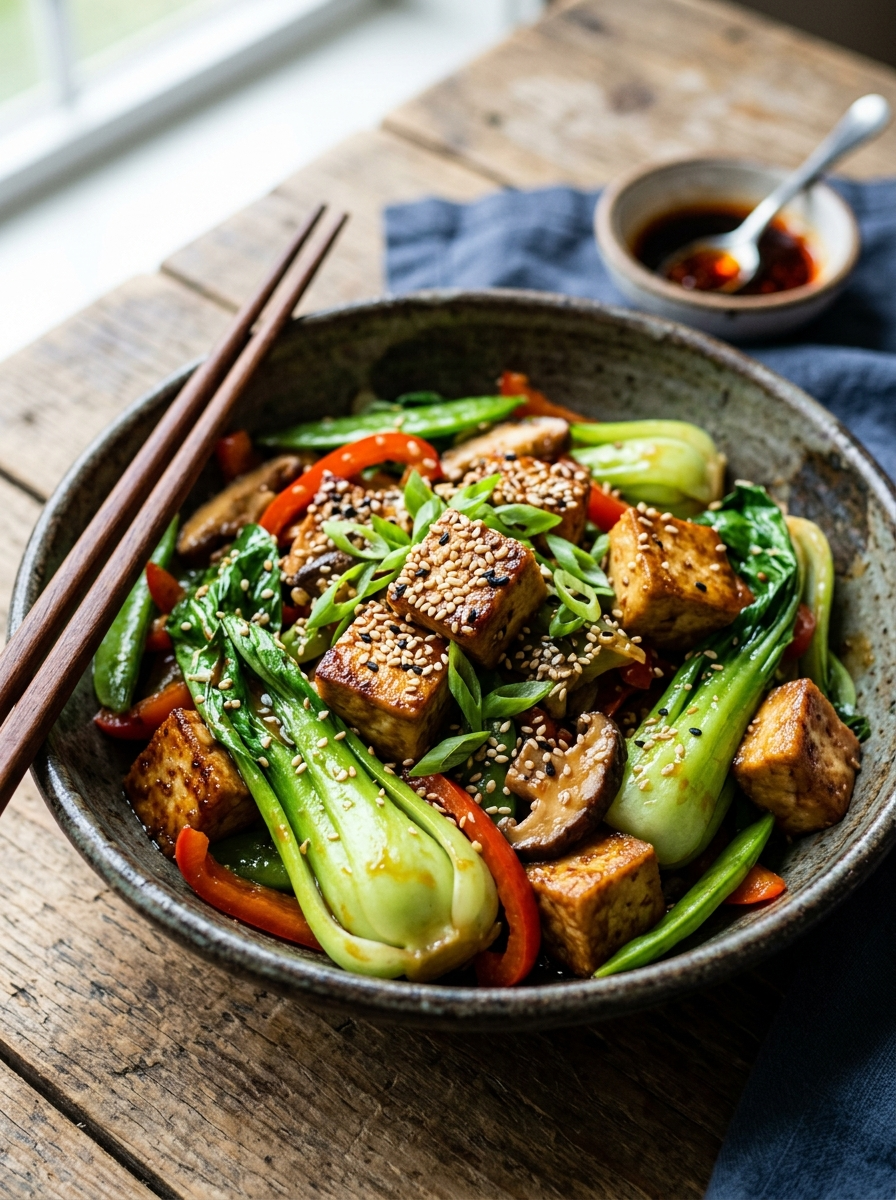
Sesame Bok Choy and Tofu Stir Fry – Quick, Crispy, and Flavor-Packed
Crispy tofu and tender bok choy come together in a bold sesame-soy sauce for a fast, satisfying bok choy tofu stir fry that works equally well over rice or noodles.
Prep: 10 minutes | Cook: 20 minutes | Servings: 4
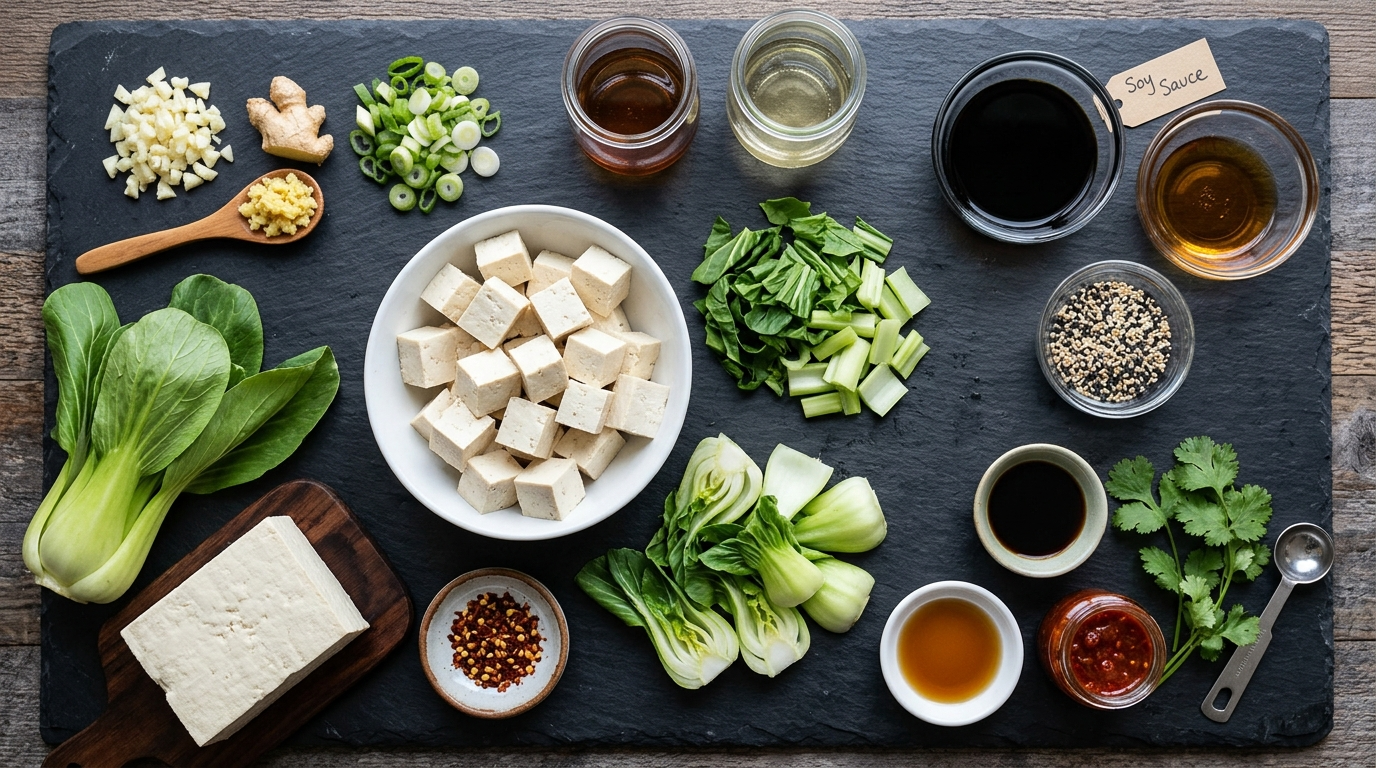
Ingredients
- 1 block (14 oz) extra-firm tofu Pressed for at least 30 minutes to remove as much moisture as possible before cutting
- 1 lb baby bok choy About 4 to 5 heads; halved lengthwise and rinsed well between leaves where grit collects
- 3 tablespoons neutral oil, divided Such as avocado oil, grapeseed oil, or vegetable oil; high smoke point required for stir frying
- 4 cloves garlic Minced finely
- 1 tablespoon fresh ginger Peeled and grated on a microplane or minced very finely
- 3 tablespoons low-sodium soy sauce Use tamari for a gluten-free version
- 1 tablespoon toasted sesame oil Used in the sauce and as a finishing drizzle; toasted gives far more flavor than plain sesame oil
- 1 tablespoon rice vinegar Unseasoned preferred
- 1 tablespoon hoisin sauce Adds depth and slight sweetness; use a gluten-free version if needed
- 1 teaspoon chili garlic sauce or sambal oelek Optional for heat; adjust to taste
- 1 teaspoon granulated sugar Balances the vinegar and soy; can substitute honey or maple syrup
- 1 teaspoon cornstarch Whisked directly into the sauce to lightly thicken it when it hits the hot pan
- 3 tablespoons water Added to the sauce to help the cornstarch dissolve and give the sauce enough liquid to coat the ingredients
- 2 teaspoons toasted sesame seeds For garnish; white or black sesame seeds both work well
- 2 stalks green onions (scallions) Thinly sliced on a diagonal for garnish
Instructions
- Press the tofu: Remove the tofu block from its packaging and drain the liquid. Wrap the block in several layers of clean paper towels or a clean kitchen towel. Place it on a flat plate and set a heavy cutting board, skillet, or a few canned goods on top. Press for a minimum of 30 minutes, or up to 1 hour, changing the towels if they become fully saturated. Longer pressing produces crispier results.
- Cut the tofu: Once pressed, unwrap the tofu and cut it into 3/4-inch cubes. Try to keep the pieces uniform so they brown evenly in the pan.
- Prepare the bok choy: Rinse each head of baby bok choy under cold running water, separating the leaves slightly to flush out any grit or soil lodged near the base. Halve each head lengthwise through the root so each half holds together. Set aside on a clean towel to dry.
- Make the sauce: In a small bowl, combine the soy sauce, toasted sesame oil, rice vinegar, hoisin sauce, chili garlic sauce (if using), granulated sugar, cornstarch, and water. Whisk until the cornstarch is fully dissolved and no lumps remain. Set the sauce next to the stove so it is ready to pour immediately when needed.
- Mince the aromatics: Mince the garlic finely and grate or mince the fresh ginger. Keep them together in a small pile since they will go into the pan at the same time.
- Sear the tofu — first side: Heat a large skillet or wok over medium-high heat until it is hot. Add 2 tablespoons of neutral oil and swirl to coat the pan. When the oil shimmers and begins to ripple, carefully add the tofu cubes in a single layer, leaving space between them. Do not move them for 3 to 4 minutes. The tofu must form a golden crust before it will release cleanly from the pan.
- Sear the tofu — remaining sides: Using a spatula, turn the tofu cubes to an uncooked side. Continue cooking and turning every 2 to 3 minutes until most sides are golden and the cubes have a firm, lightly crispy exterior, about 10 to 12 minutes total. Transfer the seared tofu to a plate and set aside.
- Cook the bok choy: Return the skillet to medium-high heat. Add the remaining 1 tablespoon of neutral oil. Place the bok choy halves cut-side down in the pan in a single layer. Cook undisturbed for 2 minutes until the cut faces develop light golden color. Flip the halves and cook for an additional 1 to 2 minutes. The stems should be just tender when pierced with a fork, and the leaves should be wilted but still bright green. If the pan is overcrowded, work in two batches.
- Add the aromatics: Push the bok choy to the edges of the pan. Add the minced garlic and grated ginger to the center of the pan. Stir them constantly for 30 to 45 seconds until fragrant. Do not let them sit still or they will scorch.
- Return the tofu and add the sauce: Add the seared tofu back to the pan. Give the sauce another quick whisk to re-suspend the cornstarch, then pour it evenly over the tofu and bok choy. Toss everything gently but thoroughly to coat. The sauce should begin to thicken within 30 to 60 seconds of hitting the heat. Cook for 1 to 2 minutes, stirring, until the sauce is glossy and coats the ingredients. If the sauce thickens too much, add water one tablespoon at a time.
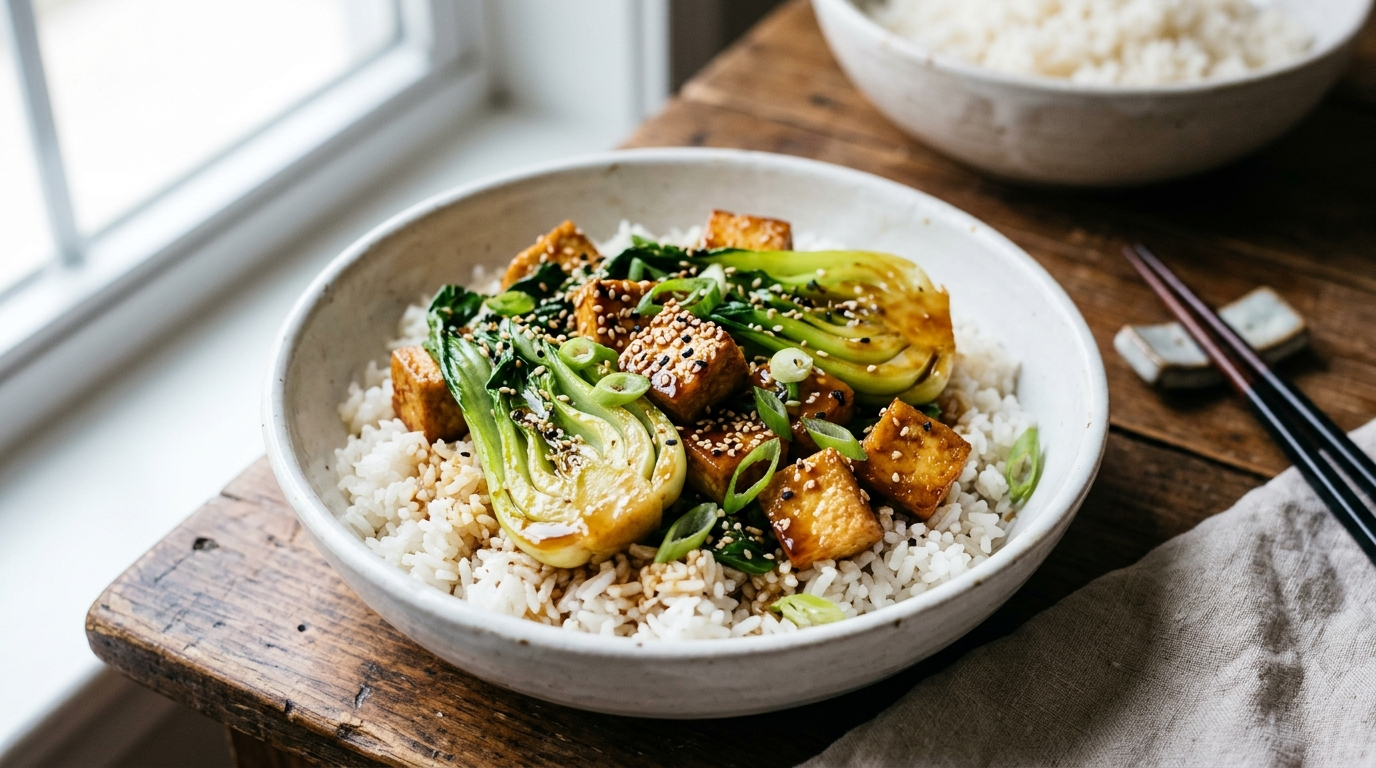
- Finish and serve: Remove the pan from heat. Taste and adjust seasoning — add a small splash more soy sauce if it needs salt, or a small splash of rice vinegar if it needs brightness. Drizzle with a small additional splash of toasted sesame oil if desired. Divide between bowls over steamed rice or noodles. Garnish with toasted sesame seeds and sliced green onions. Serve immediately.
- Store leftovers safely: Transfer any leftover stir fry into shallow airtight containers within 2 hours of cooking. Do not leave the dish at room temperature longer than 2 hours. Refrigerate at 40 F or below and use within 3 to 4 days. For longer storage, freeze in portions. When reheating, use an instant-read thermometer to confirm the food reaches an internal temperature of 165 F throughout before serving.
Stir frying as a cooking method has roots in Chinese cuisine stretching back at least to the Han Dynasty, though it became widespread and refined during the Ming Dynasty as wok technology and fuel availability improved. Bok choy — a type of Chinese cabbage whose name comes from Cantonese meaning 'white vegetable' — has been cultivated in China for thousands of years and became a staple ingredient in stir fry cooking across East and Southeast Asia. Tofu, made from coagulated soy milk, was developed in China around the 2nd century BCE and spread throughout Asia over subsequent centuries. The combination of tofu and leafy greens in a soy-and-sesame sauce reflects a long tradition of Buddhist vegetarian cooking in China, where cooks developed sophisticated techniques for making plant-based dishes deeply flavorful and texturally satisfying. Sesame oil, pressed from toasted sesame seeds, has been used as a finishing oil and flavoring agent in East Asian cooking for well over a millennium.
Practical Tips
- Pressing tofu is not optional for a stir fry — skipping this step results in tofu that releases steam in the pan, making it rubbery and preventing browning. Thirty minutes is a practical minimum; pressing overnight in the refrigerator wrapped in towels gives the best results.
- Do not crowd the tofu in the pan. If your skillet is smaller than 12 inches, sear the tofu in two batches. Crowding drops the pan temperature and the tofu will steam instead of sear.
- Have all ingredients prepped and the sauce mixed before you turn on the stove. Stir frying moves quickly and there is no time to mince garlic once the oil is hot.
- Use high heat throughout this recipe. A properly hot pan is what creates wok-style caramelization and prevents the vegetables from becoming waterlogged.
- Whisk the sauce again right before pouring it into the pan. Cornstarch settles to the bottom of the bowl quickly and must be re-suspended for even thickening.
- Baby bok choy is more tender and cooks faster than full-size bok choy. If using full-size bok choy, separate the leaves from the stalks and add the stalks to the pan 2 to 3 minutes before the leaves, since they require more cooking time.
- Toasted sesame oil has a low smoke point and a powerful flavor that degrades with high heat. It is best used in the sauce rather than as a cooking oil, or added as a finishing drizzle off the heat.
- For extra-crispy tofu without additional oil, toss the pressed and cubed tofu in 1 tablespoon of cornstarch before searing. The starch coating crisps up beautifully in the hot pan.
- Grit and soil hide between bok choy leaves near the base. Hold each head under running water and gently separate the leaves to flush it out thoroughly.
Large skillet or wok (12-inch minimum): A wide, high-sided pan gives tofu enough room to sear without steaming and allows bok choy to be tossed easily without spilling.
Cutting board: Needed for pressing and cubing tofu, halving bok choy, and mincing garlic and ginger.
Chef's knife: For clean, even cuts on all produce and tofu.
Tofu press or two flat plates with a weight: Pressing removes excess moisture from the tofu so it sears crispy rather than steaming in its own water.
Clean kitchen towels or paper towels: Used during pressing to absorb moisture released from the tofu.
Small mixing bowl: For whisking together the stir fry sauce so it is fully combined before it hits the hot pan.
Whisk or fork: To fully dissolve the cornstarch into the sauce without lumps.
Spatula or wok spatula: A flat-edged spatula allows you to flip tofu cubes cleanly and toss ingredients without crushing them.
Measuring cups and spoons: Accurate measurement of sauce ingredients ensures balanced seasoning.
Microplane or fine grater: Quickly grates fresh ginger into a fine paste that disperses evenly through the sauce.
Shallow airtight containers: For refrigerating leftovers promptly and safely in portions that cool quickly.
Instant-read thermometer: For verifying that reheated leftovers reach 165 F before serving.
Crispy Cornstarch-Coated Tofu: After pressing and cubing the tofu, toss it in 2 tablespoons of cornstarch seasoned with a pinch of salt before searing. The coating creates a noticeably thicker, crispier crust that holds up well even after the sauce is added.
Baked Tofu Version: For a lower-oil approach, bake the pressed and cubed tofu on a parchment-lined baking sheet at 400 F for 25 to 30 minutes, flipping halfway, until golden and firm. Use the baked tofu in place of pan-seared tofu in the final stir fry step.
Peanut Sesame Sauce: Add 2 tablespoons of natural peanut butter to the sauce along with 1 additional tablespoon of water. Whisk until smooth. The result is a richer, nuttier sauce that pairs especially well with noodles.
Added Vegetables: Sliced shiitake mushrooms, julienned carrots, snap peas, or thinly sliced bell peppers all work well in this dish. Add firmer vegetables like carrots and bell peppers before the bok choy so they have more time to cook. Add softer vegetables like mushrooms or snap peas at the same stage as the bok choy.
Spicy Sesame Version: Double the chili garlic sauce to 2 teaspoons and add 1/2 teaspoon of red pepper flakes to the sauce. Finish with a drizzle of chili oil before serving for a more assertive heat.
Gluten-Free Adaptation: Substitute tamari for the soy sauce and use a certified gluten-free hoisin sauce. All other ingredients in this recipe are naturally gluten-free. Verify individual product labels since formulations vary by brand.
Miso Sesame Variation: Whisk 1 tablespoon of white miso paste into the sauce in place of the hoisin sauce. Miso adds a fermented, savory depth that complements both the tofu and bok choy without adding sweetness.
Can I use silken or soft tofu instead of extra-firm?
Silken and soft tofu have a very high water content and a delicate structure that breaks apart during stir frying. They are better suited to soups, smoothies, or desserts. For this recipe, extra-firm tofu is the correct choice because it holds its shape, releases less moisture, and can be pressed and seared to a crispy exterior.
Can I make this dish ahead of time?
The stir fry is best served immediately after cooking. The bok choy softens and the tofu loses its crispiness as the dish sits. If you want to work ahead, press and cube the tofu, halve the bok choy, mince the aromatics, and mix the sauce up to a day in advance, storing each component separately in the refrigerator. Stir fry everything fresh when you are ready to eat.
How do I store and reheat leftovers safely?
Transfer leftovers into shallow airtight containers within 2 hours of cooking and refrigerate at 40 F or below. Use within 3 to 4 days. To reheat, warm the stir fry in a skillet over medium heat or in the microwave, and use an instant-read thermometer to verify the food reaches 165 F throughout before eating. For longer storage, freeze individual portions and reheat from frozen or thawed.
Why is my tofu sticking to the pan?
Tofu sticking is almost always caused by one of three things: the pan was not hot enough before the oil was added, the tofu was not pressed dry enough and is releasing steam, or you tried to flip the tofu before a crust had formed. Let the pan preheat fully, ensure the tofu is well-pressed, and resist the urge to move the tofu for at least 3 minutes after it goes in. A properly seared crust releases from the pan naturally.
What can I serve with bok choy tofu stir fry?
Steamed jasmine rice and brown rice are the most common pairings. Soba noodles, lo mein noodles, or rice noodles tossed with a small amount of sesame oil also work well. For a lower-carbohydrate option, cauliflower rice provides a neutral base. Miso soup or a simple cucumber salad dressed with rice vinegar and sesame oil make good sides.
Can I use regular full-size bok choy instead of baby bok choy?
Yes. If using full-size bok choy, separate the thicker stalks from the leafy tops. Cut the stalks into 1-inch pieces and add them to the pan 2 to 3 minutes before adding the leafy greens, since the stalks take longer to become tender. The flavor is similar; the texture of full-size bok choy stalks is slightly more substantial.
Is this recipe vegan?
As written, yes — every ingredient in this recipe is plant-based. Verify individual product labels for hoisin sauce and chili garlic sauce, as some commercial brands include shellfish-derived ingredients. Choosing certified vegan versions of those condiments ensures the dish remains fully vegan.
My sauce turned out too salty. What went wrong?
The saltiness likely came from using regular soy sauce rather than low-sodium soy sauce, or from a particularly salty hoisin brand. The recipe specifies low-sodium soy sauce specifically to avoid this. If the dish is already finished and too salty, a squeeze of fresh lime juice or an extra splash of rice vinegar can help balance it. For future batches, taste the sauce before it goes into the pan and adjust.