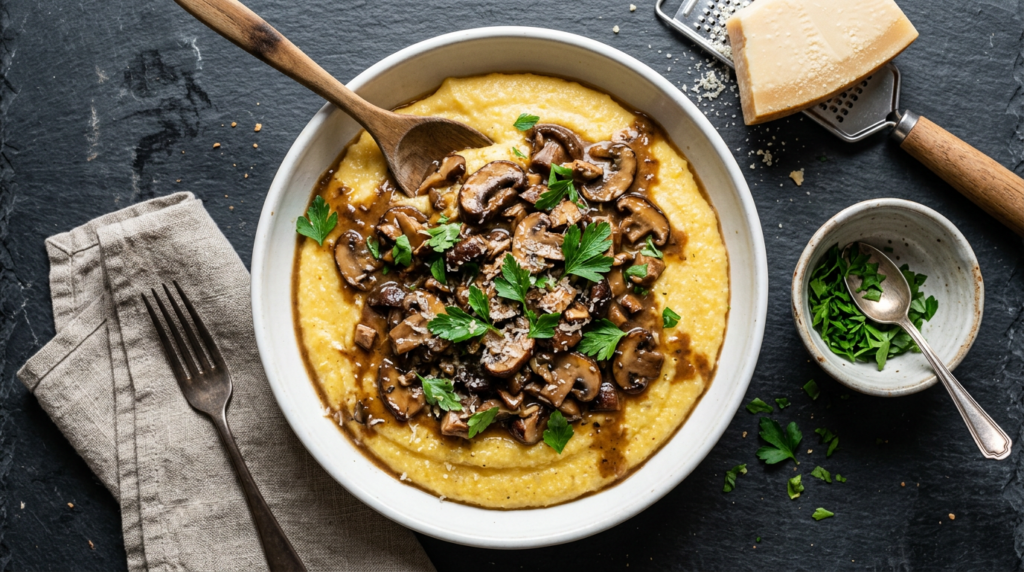
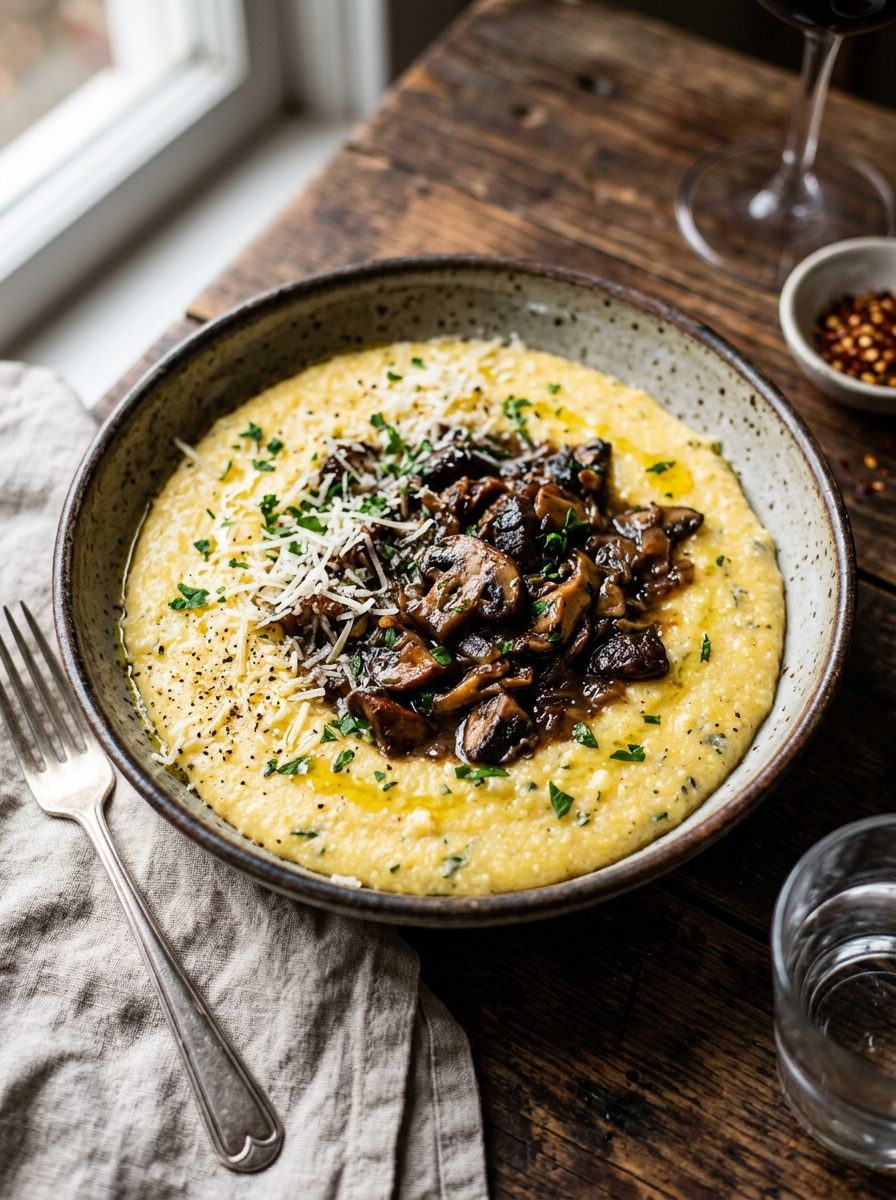
Creamy polenta with mushroom ragout is one of those dishes that feels indulgent without requiring complicated technique. The polenta cooks slowly in a mixture of water and milk, absorbing liquid gradually until it becomes thick, smooth, and rich with butter and Parmesan. Meanwhile, a mixture of cremini, shiitake, and dried porcini mushrooms braises down into a glossy, herb-scented ragout that pools beautifully over each serving.
This is a naturally vegetarian meal that satisfies in the same way a braised meat dish does, because mushrooms are genuinely high in umami compounds. The porcini soaking liquid is used as a built-in stock, deepening the ragout without any extra shopping. If you have never made polenta from scratch, the main skill involved is patience and consistent stirring – the results are far superior to instant versions. Plan for about 45 minutes of active cooking once your mise en place is complete.
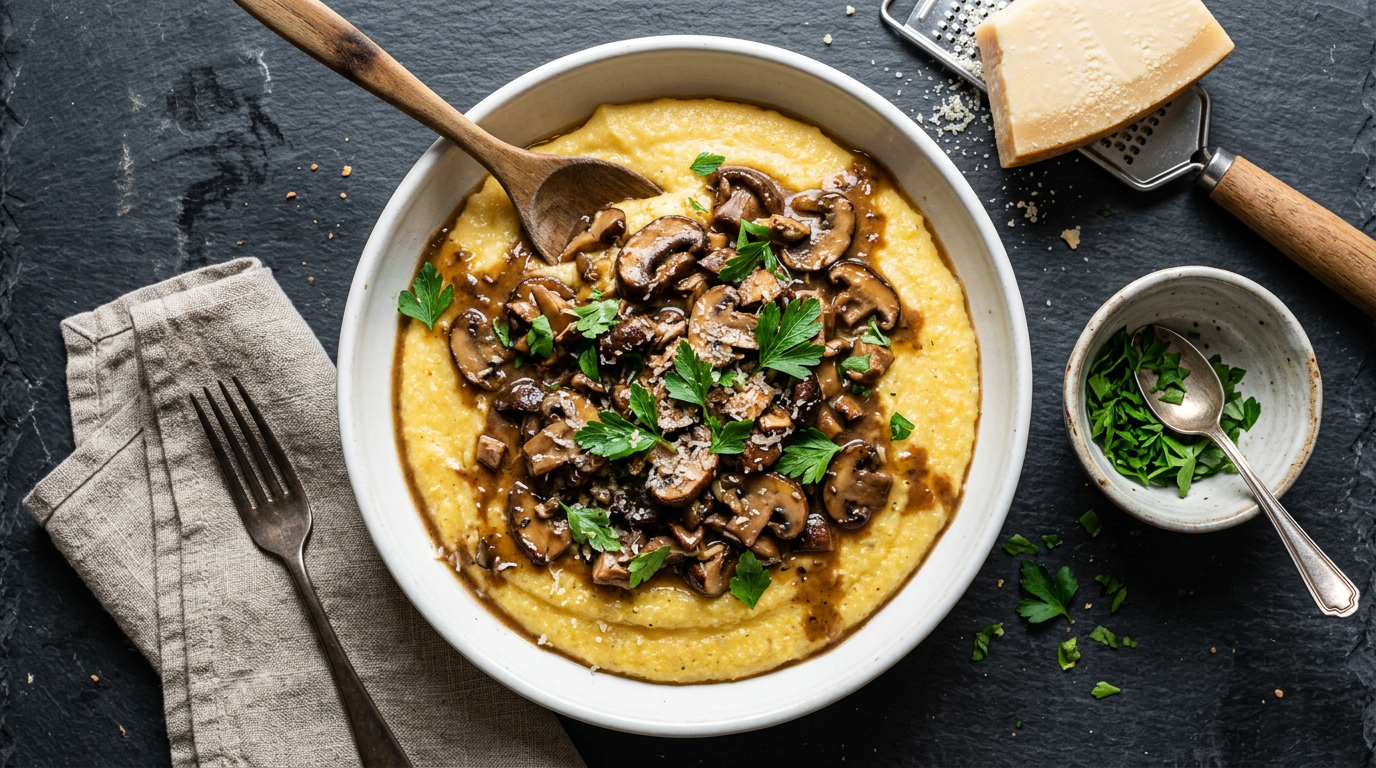
Creamy Polenta with Mushroom Ragout – FlavorGrub Home Cooking
Silky stone-ground polenta meets a deeply savory mixed mushroom ragout in this hearty vegetarian dinner. Clear steps, complete quantities, and practical tips make this Italian-inspired classic achievable on any weeknight.
Prep: 20 minutes | Cook: 50 minutes | Servings: 4
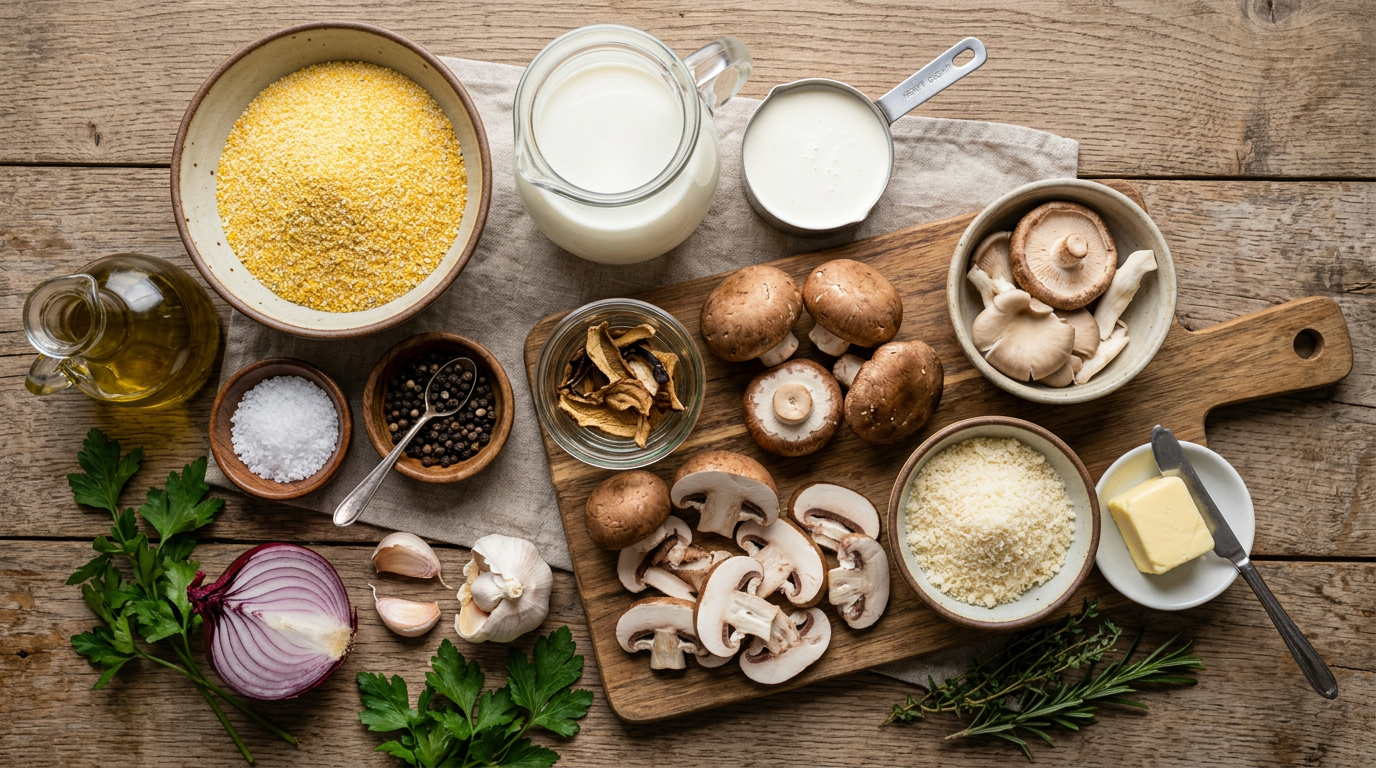
Ingredients
- 1 oz dried porcini mushrooms About 1 loosely packed cup; soak in hot water to rehydrate
- 1.5 cups hot water For soaking the dried porcini; not boiling, about 180 F
- 3 tablespoons extra-virgin olive oil Divided; 1 tablespoon for polenta, 2 tablespoons for ragout
- 1 medium yellow onion Finely diced, about 1 cup
- 4 cloves garlic Minced
- 12 oz cremini mushrooms Sliced about 1/4-inch thick; also called baby bella
- 6 oz shiitake mushrooms Stems removed and discarded or reserved for stock; caps sliced 1/4-inch thick
- 0.5 teaspoon kosher salt For mushroom ragout; adjust to taste
- 0.25 teaspoon black pepper Freshly ground
- 1 tablespoon tomato paste Adds depth and color to the ragout
- 0.5 cup dry white wine Such as Pinot Grigio or Sauvignon Blanc; substitute with additional vegetable broth if preferred
- 1 cup vegetable broth Low-sodium preferred so you can control final salt level
- 2 sprigs fresh thyme Leaves stripped; or 1/2 teaspoon dried thyme
- 1 sprig fresh rosemary About 4 inches; finely chopped; or 1/4 teaspoon dried rosemary
- 1 tablespoon unsalted butter Stirred into ragout at the end for gloss
- 2 teaspoons fresh lemon juice Brightens the ragout at the finish
- 2 tablespoons fresh flat-leaf parsley Roughly chopped; for garnish
- 3 cups water For polenta base
- 1 cup whole milk Adds creaminess; substitute with additional water or unsweetened oat milk for dairy-free
- 1 teaspoon kosher salt For polenta cooking liquid; taste and adjust as polenta thickens
- 1 cup stone-ground coarse polenta or coarse cornmeal Not instant; look for labels that say 'coarse grind' or 'stone-ground'; cook time is 35 to 45 minutes
- 3 tablespoons unsalted butter Stirred into polenta at the end for richness
- 0.75 cup Parmigiano-Reggiano Freshly grated on the small holes of a box grater; about 2 oz; plus extra for serving
- 0.25 teaspoon white pepper or black pepper For finishing the polenta
Instructions
- Place the dried porcini mushrooms in a small heatproof bowl. Pour 1.5 cups of hot water (about 180 F, not boiling) over them. Press them down so they are submerged. Let them soak for 25 to 30 minutes until fully softened.
- After soaking, lift the porcini out of the liquid with your fingers or a slotted spoon and transfer them to a cutting board. Squeeze out excess liquid back into the bowl. Roughly chop the reconstituted porcini into bite-sized pieces and set aside.
- Carefully pour the porcini soaking liquid through a fine-mesh strainer lined with a paper towel or cheesecloth into a measuring cup, leaving the last tablespoon or so behind in the bowl (grit settles at the bottom). You should have about 1 cup of strained porcini liquid. Set aside.
- Begin the polenta while the porcini soak. Combine 3 cups of water, 1 cup of whole milk, and 1 teaspoon of kosher salt in a large heavy-bottomed saucepan. Bring to a bare simmer over medium heat, stirring occasionally. Do not let it boil hard before adding the polenta or the milk may scorch.
- Once the liquid is simmering, reduce heat to medium-low. Slowly pour in the polenta in a thin, steady stream while whisking constantly. Continue whisking for 2 minutes after all the polenta is added to prevent lumps from forming.
- Switch from the whisk to a wooden spoon. Continue cooking the polenta over low heat, stirring thoroughly every 2 to 3 minutes, scraping the bottom and sides of the pot. The polenta will thicken considerably over 35 to 45 minutes. It is ready when it pulls cleanly away from the sides of the pot and a spoonful mounds on itself without spreading. Taste and adjust salt.
- While the polenta cooks, make the mushroom ragout. Heat 2 tablespoons of olive oil in a large 12-inch skillet over medium-high heat until shimmering.
- Add the sliced cremini and shiitake mushrooms in a single layer. Do not stir for the first 3 minutes so they can develop color on one side. Season with 0.5 teaspoon kosher salt and 0.25 teaspoon black pepper, then toss and continue cooking another 3 to 4 minutes until the mushrooms are golden brown and their liquid has evaporated. Work in two batches if the skillet feels crowded – overcrowding causes steaming rather than browning. Transfer browned mushrooms to a plate.
- Reduce heat to medium. Add 1 tablespoon olive oil to the same skillet. Add the diced onion and cook, stirring occasionally, for 5 minutes until softened and lightly golden.
- Add the minced garlic, fresh thyme leaves, and chopped rosemary. Cook, stirring constantly, for 60 seconds until fragrant.
- Add the tomato paste and stir it into the aromatics. Cook for 1 to 2 minutes until the tomato paste darkens slightly and smells less sharp.
- Pour in the dry white wine. Stir and scrape up any browned bits from the bottom of the skillet. Let the wine reduce by half, about 2 to 3 minutes.
- Return the browned cremini and shiitake mushrooms to the skillet along with the chopped reconstituted porcini. Stir to combine.
- Add the strained porcini soaking liquid and 1 cup of vegetable broth. Stir well. Bring to a simmer, then reduce heat to medium-low. Cook uncovered for 12 to 15 minutes, stirring occasionally, until the sauce has reduced and thickened to a glossy, spoonable consistency that coats the mushrooms.
- Remove the ragout from heat. Stir in 1 tablespoon of unsalted butter and 2 teaspoons of fresh lemon juice. Taste and adjust salt and pepper. Keep warm over the lowest possible heat while you finish the polenta.
- When the polenta is fully cooked and thick, remove from heat. Stir in 3 tablespoons of unsalted butter, the grated Parmigiano-Reggiano, and 0.25 teaspoon of white or black pepper. Stir vigorously until the butter and cheese are fully melted and the polenta is glossy and smooth. Taste and adjust salt.
- To serve, spoon a generous mound of creamy polenta into the center of each of four wide shallow bowls. Ladle the mushroom ragout over the top. Finish with freshly chopped parsley and extra grated Parmigiano-Reggiano. Serve immediately, as polenta thickens quickly once plated.
- For leftovers: allow the polenta and ragout to cool briefly – no more than 2 hours total at room temperature. Transfer them to separate shallow airtight containers in portions and refrigerate at 40 F or below. Use within 3 to 4 days. To freeze, portion cooled polenta into individual servings in freezer-safe containers; freeze for up to 2 months.
- To reheat: warm the ragout in a small saucepan over medium heat, stirring frequently, until it reaches an internal temperature of 165 F. Reheat polenta in a small saucepan over medium-low heat with a splash of water or milk, stirring constantly until loosened and heated through to 165 F. If reheating from frozen, thaw polenta overnight in the refrigerator before reheating.
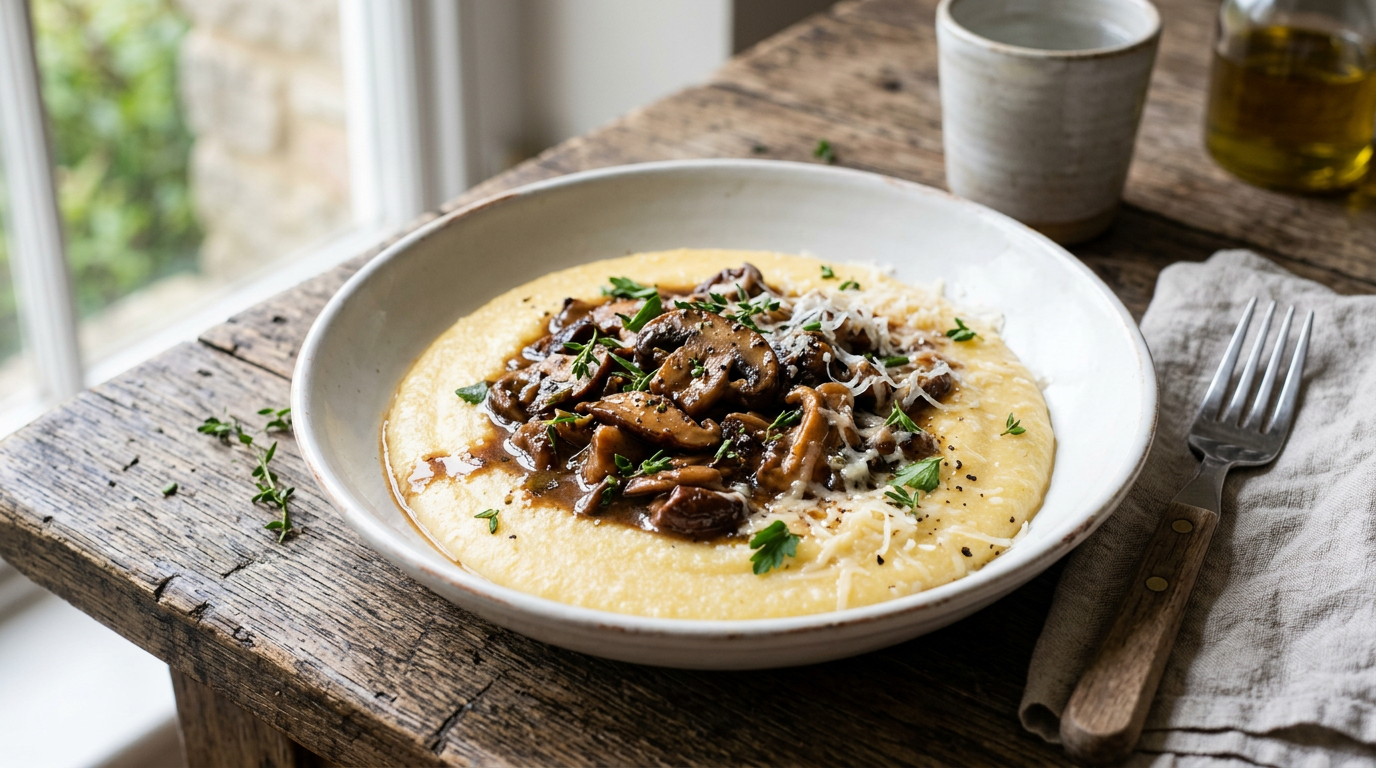
Polenta has been a staple of northern Italian cooking, particularly in the regions of Lombardy, Veneto, and Friuli-Venezia Giulia, since at least the 16th century when corn arrived in Europe from the Americas and replaced older grain porridges made from spelt or millet. For centuries polenta was peasant food, eaten plain or with whatever was available. Mushroom ragout – a slow-cooked, sauce-like preparation of mushrooms with aromatics and wine – became a natural pairing because wild mushrooms were abundant in northern Italian forests. Porcini (Boletus edulis) in particular became iconic in Italian cuisine and are now traded dried worldwide, lending their concentrated flavor to sauces and braises year-round. The combination of polenta and mushroom ragout appears in traditional Lombard and Venetian cooking and has been adopted broadly in modern vegetarian and restaurant cuisine.
Practical Tips
- Use coarse stone-ground polenta, not instant or quick-cooking. Instant polenta produces a gluey, flat-tasting result. The 35 to 45 minutes of cooking time for coarse polenta develops a sweeter corn flavor and more complex texture.
- Stir the polenta consistently but you do not need to stir without stopping. A thorough stir every 2 to 3 minutes while maintaining low heat is sufficient and prevents the bottom from scorching.
- Do not crowd the mushrooms in the skillet. If you pile too many mushrooms at once, they release steam and become soft and grey instead of browning. Work in batches for the best caramelized flavor.
- The porcini soaking liquid is a free, deeply flavored stock. Always strain it through a paper towel-lined strainer and leave the last bit in the bowl to avoid adding grit to the ragout.
- If your polenta seizes up and becomes too thick before serving, stir in hot water or warm milk a tablespoon at a time over low heat until it loosens to a pourable consistency. This is normal and easy to fix.
- For a more pronounced umami flavor, add 1 tablespoon of soy sauce or a teaspoon of miso paste to the ragout along with the broth. Neither will make the dish taste Asian – they simply amplify the savory depth.
- Taste the polenta for salt after adding the cheese, not before, because Parmigiano-Reggiano adds significant salt.
- Polenta thickens as it sits in the bowl. Serve it slightly looser than you think you want it – it will reach the right consistency by the time guests eat it.
- Fresh thyme and rosemary make a noticeable difference here, but dried herbs work. If using dried, add them with the onion rather than with the garlic to give them more time to bloom in the oil.
Large heavy-bottomed saucepan or Dutch oven (at least 4-quart): Essential for cooking polenta without scorching; heavy base distributes heat evenly
Large skillet (12-inch): Gives mushrooms enough surface area to brown rather than steam
Small heatproof bowl: For rehydrating dried porcini mushrooms in hot water
Fine-mesh strainer or cheesecloth: Strains grit from porcini soaking liquid before adding it to the ragout
Wooden spoon or silicone spatula: For continuous stirring of polenta without scratching the pot
Whisk: Helps incorporate polenta into liquid smoothly at the start to prevent lumps
Ladle: For portioning polenta into bowls cleanly
Chef's knife and cutting board: For slicing and chopping mushrooms and aromatics
Instant-read thermometer: To verify polenta reaches a safe internal temperature and to check reheated leftovers reach 165 F
Shallow airtight containers: For safe, rapid chilling and storage of leftovers
Vegan Version: Replace whole milk in the polenta with unsweetened oat milk or additional water. Replace both butter additions in the polenta with high-quality extra-virgin olive oil (use 2 tablespoons). Omit the Parmigiano-Reggiano or use a vegan hard cheese alternative. Replace the butter finish in the ragout with 1 tablespoon of olive oil. All other steps remain the same.
Soft-Set Polenta with Gorgonzola: Replace the Parmigiano-Reggiano with 2 oz of crumbled Gorgonzola dolce stirred in at the end. The polenta will be sharper and creamier. Pairs especially well with the earthiness of the mushroom ragout. Keep the polenta slightly looser as the gorgonzola will firm it up quickly.
Polenta with Chicken and Mushroom Ragout: Add 1 lb of boneless skinless chicken thighs, cut into 1-inch pieces, to the ragout. After browning the mushrooms, brown the chicken pieces in the same skillet in a single layer over medium-high heat for 3 to 4 minutes per side until cooked through to an internal temperature of 165 F verified with an instant-read thermometer. Remove and set aside. Proceed with the onion and aromatics, return the chicken with the mushrooms, and braise together in the liquids. The final ragout will be heartier and protein-rich.
Baked Polenta Squares with Ragout: Pour the finished creamy polenta into a lightly oiled 9-by-13-inch baking dish. Smooth the top. Let cool uncovered for 15 minutes, then refrigerate until firm, at least 1 hour. Cut into squares or rectangles. Pan-fry the squares in olive oil over medium-high heat for 3 to 4 minutes per side until golden and crispy on the outside. Top with warmed mushroom ragout and serve as an appetizer or alternative plating.
Herb and Truffle Oil Finish: Drizzle 0.5 teaspoon of black truffle oil over each bowl just before serving. Use a light hand – truffle oil is potent and a small amount is sufficient. Add a few fresh thyme leaves as an additional garnish. This elevates the dish for a special occasion without changing the core recipe.
What is the difference between polenta and cornmeal?
Polenta and cornmeal are made from dried ground corn, but the terms differ in grind size and intended use. Polenta typically refers to coarse or medium-coarse ground dried corn that is cooked into a porridge. Cornmeal sold in the United States can range from fine to coarse. For this recipe, look for a bag labeled 'coarse cornmeal,' 'stone-ground polenta,' or simply 'coarse grind.' Fine cornmeal will cook too quickly and produce a pasty texture rather than the creamy, slightly textured result this dish calls for.
Can I use instant or quick-cooking polenta?
You can, but the texture and flavor will be noticeably different. Instant polenta cooks in 5 minutes and produces a smoother but blander result. If substituting, follow the package instructions for liquid ratios and cook time, then finish with the same butter, Parmesan, and seasoning. The ragout recipe remains unchanged.
What mushrooms work best for the ragout?
Cremini and shiitake are the two fresh mushrooms used here because they brown well and have distinct flavors – cremini are mild and meaty, shiitake are more savory and earthy. The dried porcini add concentrated umami. Other options that work well include oyster mushrooms, maitake (hen of the woods), or portobello cut into chunks. Avoid very delicate mushrooms like enoki, which do not hold up to braising.
How do I store and reheat leftover polenta?
Transfer polenta to shallow airtight containers within 2 hours of cooking and refrigerate at 40 F or below. Use within 3 to 4 days. Polenta solidifies when cold, which is normal. To reheat, place it in a small saucepan over medium-low heat with a splash of water or milk, stirring constantly until it loosens and heats through to an internal temperature of 165 F. You may need to add liquid gradually – start with 2 tablespoons and add more as needed.
Can I make the ragout ahead of time?
Yes. The mushroom ragout reheats very well and is an ideal make-ahead component. Cook the ragout completely, let it cool briefly, then transfer to shallow airtight containers and refrigerate within 2 hours at 40 F or below. Store for up to 3 to 4 days. Reheat in a saucepan over medium heat, stirring frequently, until it reaches 165 F. The polenta is best made fresh because it thickens and sets as it cools, though it can also be reheated with added liquid as described above.
My polenta has lumps. What did I do wrong and how do I fix it?
Lumps usually form when the polenta is added to the liquid too quickly, or when the liquid is not being stirred during addition. To fix lumps in a finished polenta, press them against the side of the pot with the back of your spoon while stirring. For stubborn lumps, use an immersion blender for 10 to 15 seconds to smooth the texture. Next time, add the polenta in a very thin, steady stream while whisking constantly from the start.
Is this dish gluten-free?
Stone-ground polenta is naturally gluten-free as it is made from corn. However, cross-contamination can occur in facilities that also process wheat. If gluten is a concern for health reasons, look for polenta specifically labeled gluten-free. Check the vegetable broth label as well, since some commercial broths contain wheat-based flavorings. The rest of the ingredients in this recipe are naturally gluten-free.
Can I make this without wine?
Yes. Replace the white wine with an equal amount of additional vegetable broth plus 1 teaspoon of white wine vinegar or apple cider vinegar stirred in at the same stage. The vinegar approximates the acidity that wine provides and helps lift the browned fond from the pan.