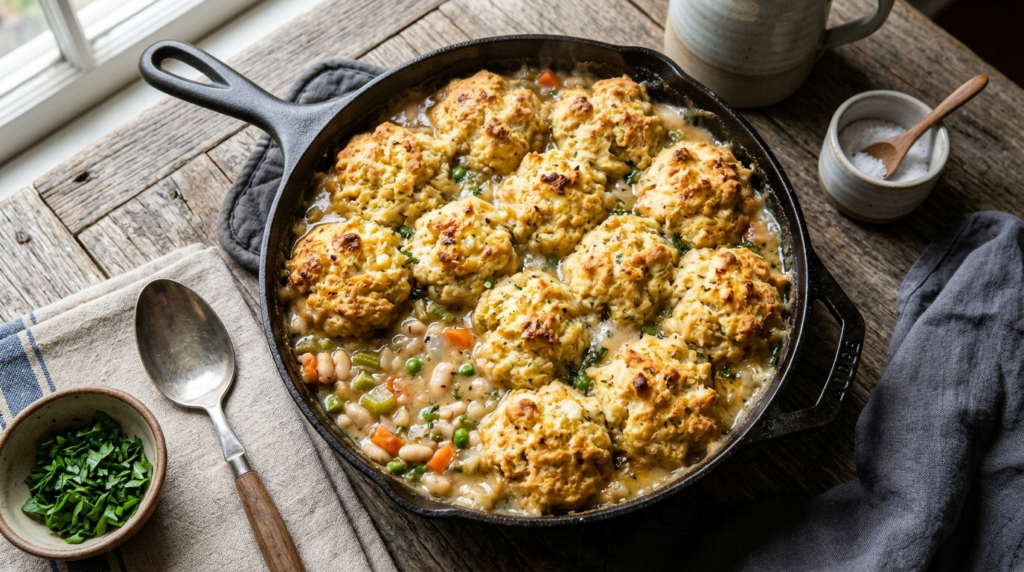
Pot pie is one of the most satisfying forms of comfort food, and this white bean version proves you don't need meat to achieve deep, hearty flavor. Creamy cannellini beans take the place of chicken or turkey, providing plenty of protein and a velvety texture that melds beautifully with a thickened vegetable broth filling. Leeks, carrots, celery, and peas round out the filling with color and sweetness, while fresh thyme and a splash of white wine lift everything with a little brightness.
Instead of a rolled pastry crust—which can be fussy to handle—the topping here is a simple drop biscuit dough spooned directly onto the hot filling. As the pot pie bakes, the biscuits puff and turn golden on top while their undersides soak up steam from the filling, keeping them tender throughout. The result is a bubbling, deeply savory dish that comes together in a single oven-safe skillet or baking dish, making cleanup straightforward. This recipe is comfortably vegetarian and can be adapted for a vegan table with a few easy swaps listed in the variations section.
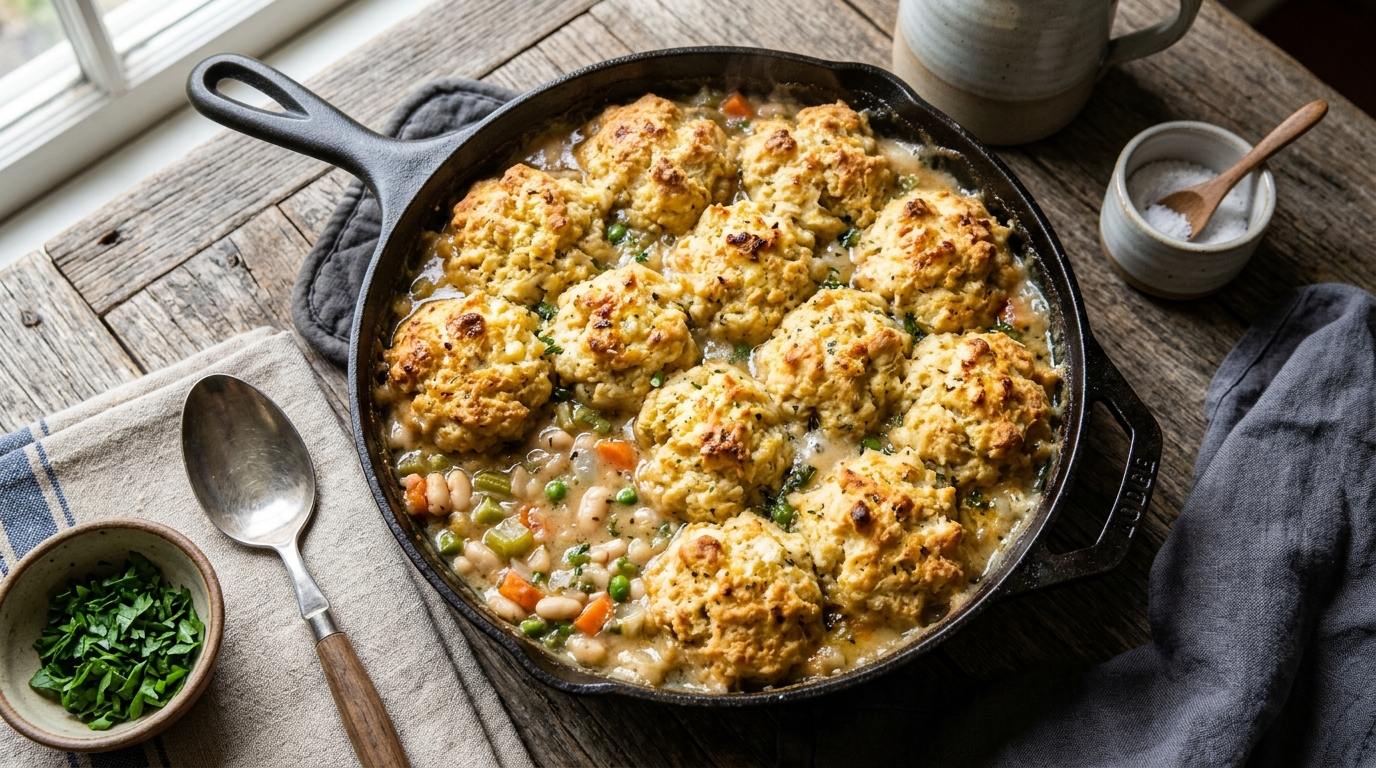
White Bean Biscuit Pot Pie – Hearty Vegetarian Comfort Food
This white bean biscuit pot pie layers a savory, herb-scented filling of cannellini beans and vegetables beneath a golden drop biscuit topping—no rolling pin required.
Prep: 25 minutes | Cook: 45 minutes | Servings: 6
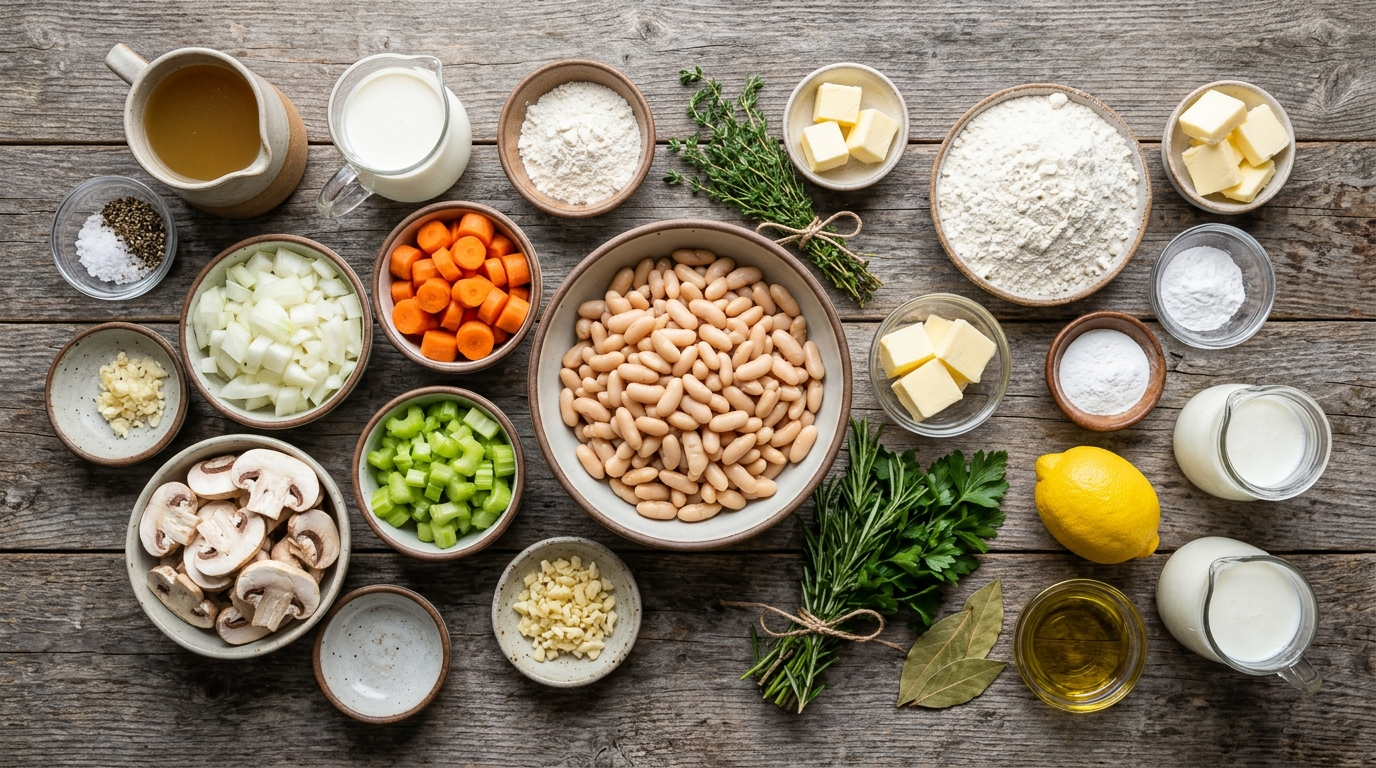
Ingredients
- 3 tablespoons unsalted butter For sautéing the filling vegetables
- 1 large leek, white and light green parts only Halved lengthwise, sliced into half-moons, rinsed well to remove grit
- 3 medium carrots Peeled and diced into roughly 1/2-inch pieces
- 3 stalks celery Diced into roughly 1/2-inch pieces
- 4 cloves garlic Minced
- 1/3 cup dry white wine Such as Pinot Grigio or Sauvignon Blanc; substitute with additional broth if preferred
- 3 tablespoons all-purpose flour For thickening the filling
- 2.5 cups vegetable broth Low-sodium preferred so you can control salt level
- 1/2 cup whole milk Adds richness to the filling; see variations for dairy-free option
- 2 15-ounce cans cannellini beans Drained and rinsed; about 3 cups cooked beans total
- 1 cup frozen peas Added at the end of filling prep; no thawing needed
- 2 teaspoons fresh thyme leaves Or 3/4 teaspoon dried thyme
- 1 teaspoon fresh rosemary Finely minced; or 1/4 teaspoon dried rosemary
- 1 tablespoon Dijon mustard Adds depth and a mild tang to the filling
- 1 teaspoon kosher salt For the filling; adjust to taste depending on broth saltiness
- 1/2 teaspoon black pepper Freshly ground
- 1 tablespoon lemon juice Fresh; brightens the finished filling
- 2 cups all-purpose flour For the biscuit topping
- 1 tablespoon baking powder For leavening the biscuits
- 1/2 teaspoon baking soda Works with the buttermilk for extra lift
- 3/4 teaspoon kosher salt For the biscuit dough
- 1/2 teaspoon garlic powder Optional but adds savory flavor to the biscuits
- 6 tablespoons cold unsalted butter Cut into 1/4-inch cubes and kept refrigerated until use
- 3/4 cup cold buttermilk Plus up to 2 tablespoons more if dough seems dry; keep cold
- 1/2 cup shredded sharp cheddar cheese Optional but recommended; stir into biscuit dough
- 1 tablespoon buttermilk or melted butter For brushing the tops of the biscuits before baking
Instructions
- Position an oven rack in the center of the oven and preheat to 425 F. Place a rimmed baking sheet on a lower rack to catch drips.
- Make the biscuit dough first so it can rest cold while you prepare the filling. In a large bowl, whisk together 2 cups all-purpose flour, 1 tablespoon baking powder, 1/2 teaspoon baking soda, 3/4 teaspoon kosher salt, and 1/2 teaspoon garlic powder (if using).
- Add the cold cubed butter to the flour mixture. Using a pastry cutter or two forks, work the butter into the flour until the mixture resembles coarse crumbs with some pea-sized butter pieces still visible. These butter pieces create flaky layers as the biscuits bake.
- If using cheddar, stir it into the flour-butter mixture now. Add 3/4 cup cold buttermilk and stir gently with a fork just until a shaggy, sticky dough comes together. If the dough seems dry and crumbly, add buttermilk one tablespoon at a time up to 2 additional tablespoons. Do not overmix or the biscuits will be tough. Cover the bowl and refrigerate the dough while you make the filling.
- In a 12-inch oven-safe skillet, melt 3 tablespoons unsalted butter over medium heat. Add the sliced leek, diced carrots, and diced celery. Cook, stirring occasionally, for 8 to 10 minutes until the vegetables have softened and the leeks are translucent.
- Add the minced garlic, fresh thyme, and minced rosemary. Cook, stirring constantly, for 1 minute until fragrant.
- Pour in the white wine and stir, scraping up any browned bits from the bottom of the pan. Cook for 2 minutes until most of the wine has evaporated.
- Sprinkle 3 tablespoons of all-purpose flour over the vegetables and stir to coat evenly. Cook for 1 to 2 minutes, stirring constantly, to cook out the raw flour taste.
- While whisking constantly, slowly pour in the vegetable broth in a steady stream. Whisk until smooth and no flour lumps remain. Then pour in the 1/2 cup milk and whisk to combine.
- Add the Dijon mustard, 1 teaspoon kosher salt, and 1/2 teaspoon black pepper. Stir well. Bring the mixture to a gentle boil over medium-high heat, then reduce heat to medium and cook, stirring frequently, for 4 to 5 minutes until the filling has thickened to a gravy-like consistency that coats the back of a spoon.
- Stir in the drained cannellini beans and frozen peas. Cook for 2 minutes until the beans are heated through. Remove the skillet from heat and stir in 1 tablespoon lemon juice. Taste and adjust salt and pepper as needed. The filling should be well-seasoned and slightly loose—it will thicken further in the oven.
- If your skillet is not oven-safe, transfer the filling to a lightly greased 3-quart baking dish at this point.
- Remove the biscuit dough from the refrigerator. Using a large spoon or a 1/4-cup measuring cup, drop portions of dough over the surface of the hot filling, spacing them roughly 1/2 inch apart. You should have 8 to 10 biscuit mounds. They do not need to cover every inch of the filling—gaps allow steam to escape and the filling to bubble up attractively.
- Brush the tops of the biscuit mounds lightly with buttermilk or melted butter.
- Place the skillet on the preheated oven's center rack, over the baking sheet below. Bake at 425 F for 20 to 25 minutes, until the biscuit tops are deep golden brown and an instant-read thermometer inserted into the center of a biscuit reads at least 200 F. The filling should be bubbling around the edges.
- Remove from the oven and let the pot pie rest for 10 minutes before serving. This allows the filling to settle and thicken slightly, making it easier to spoon into bowls without being watery.
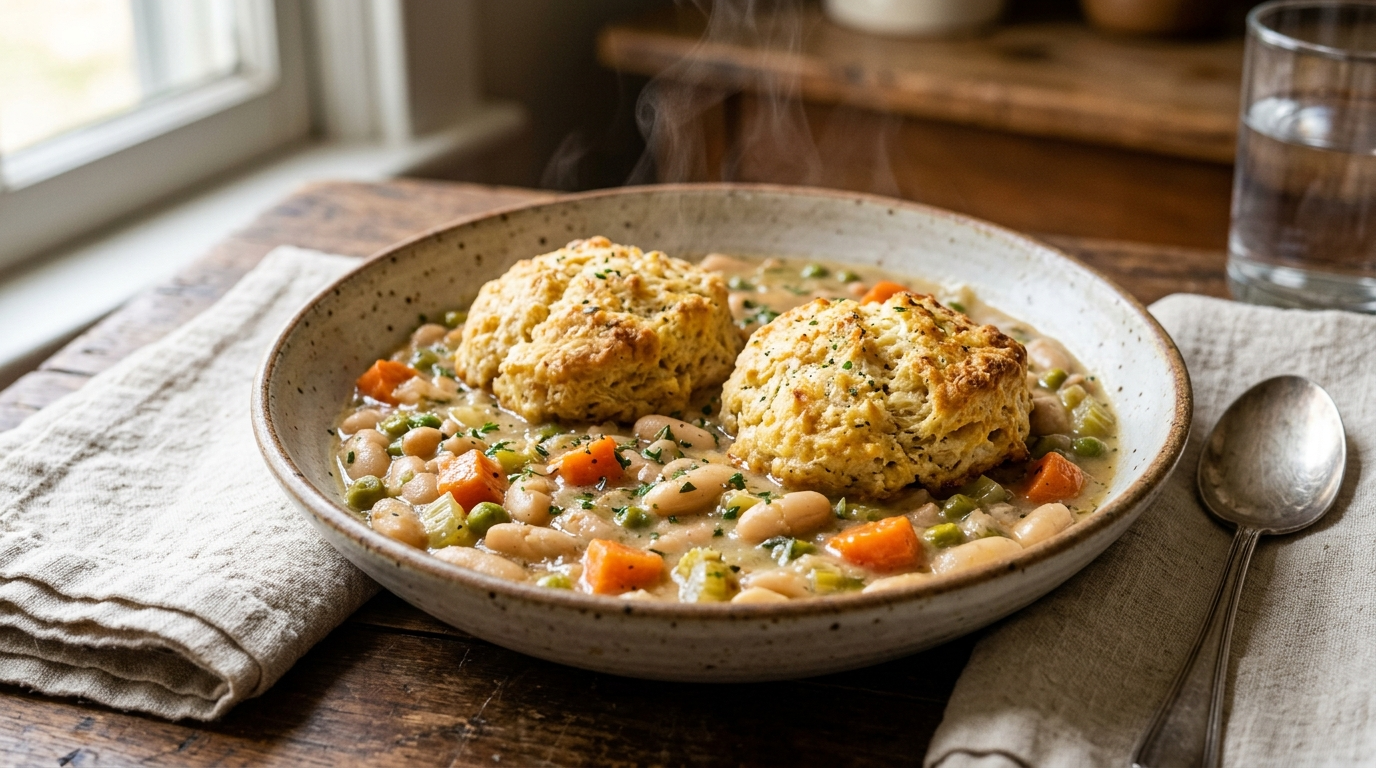
- Serve by scooping a biscuit or two along with a generous portion of filling into each bowl.
- Store leftovers promptly. Within 2 hours of cooking, transfer leftovers to shallow airtight containers and refrigerate at 40 F or below. Use within 3 to 4 days. For longer storage, freeze individual portions in freezer-safe containers for up to 3 months.
- To reheat refrigerated leftovers, warm in a 350 F oven covered loosely with foil until an instant-read thermometer reads 165 F throughout, approximately 20 to 25 minutes depending on portion size. Alternatively, reheat individual portions in a microwave, stirring the filling midway, until the filling reaches 165 F. The biscuit topping will soften when reheated; this is expected.
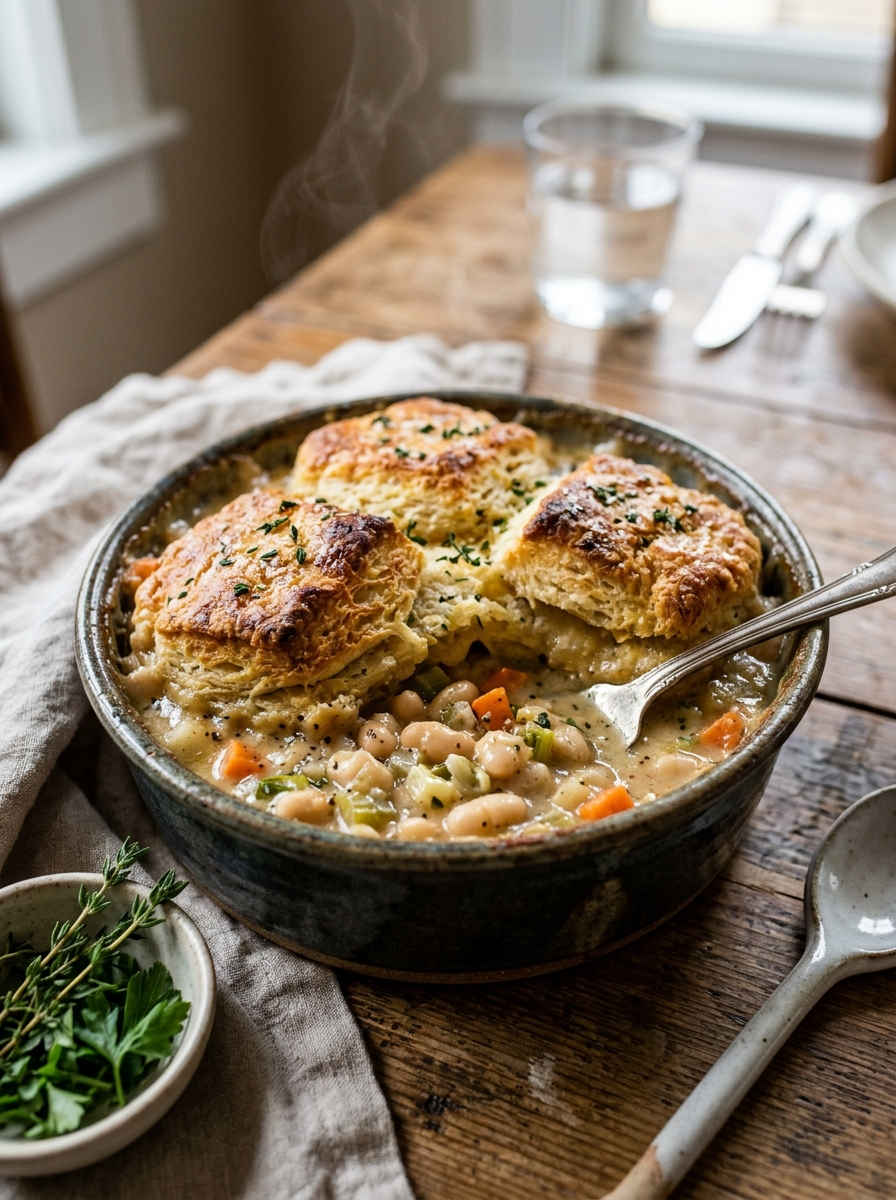
Pot pie in some form dates to medieval Europe, where cooks baked savory fillings inside thick pastry shells called 'coffins' that served as edible vessels. By the colonial American period, pot pies were a common way to stretch small quantities of meat or beans with root vegetables and gravy. The biscuit-topped variation—sometimes called a cobbler-style pot pie—became popular in the American South and Appalachian regions, where cooks dropped rough biscuit dough over stewed fillings rather than rolling out a top crust. White beans, particularly navy beans and Great Northern beans, have been a staple ingredient in American home cooking for centuries, prized for their mild flavor, creamy interior, and ability to absorb surrounding seasonings. Cannellini beans, the larger Italian variety used here, became widely available in American grocery stores in the late twentieth century and are now a common pantry staple.
Practical Tips
- Keep the butter for the biscuit dough as cold as possible throughout the process. Warm butter melts into the flour instead of creating separate layers, resulting in a dense rather than flaky biscuit. If your kitchen is warm, return the flour-butter mixture to the refrigerator for 10 minutes before adding buttermilk.
- Rinse the sliced leeks in a bowl of cold water and lift them out with your hands before using. Leeks trap significant amounts of sand and soil between their layers, and rinsing them thoroughly prevents grit in the finished dish.
- The filling should be visibly saucy before the biscuits go on top. If it looks too thick at that stage, stir in 2 to 3 tablespoons of additional broth. A too-thick filling can become pasty once baked.
- If your oven-safe skillet has a metal handle that gets very hot in the oven, use a double layer of heavy-duty foil wrapped around the handle as a heat shield, or use oven mitts that cover your forearms when removing the skillet.
- Do not stir the biscuit dough after it comes together. Overmixing develops gluten, which makes the biscuits chewy rather than tender.
- Mashing roughly one-quarter of the beans with a fork before adding them to the filling gives the sauce extra body and creaminess without any additional thickeners.
- If the biscuit tops brown before the filling is bubbling and the biscuit interiors are cooked through, loosely tent the skillet with foil for the remaining bake time.
- Lemon juice added at the end of filling preparation is important—it balances the richness of the butter and milk and brightens all the savory flavors. Do not skip it.
12-inch oven-safe skillet or 3-quart baking dish: Holds the filling and biscuit topping and goes directly from stovetop to oven
Large mixing bowl: For mixing the drop biscuit dough
Pastry cutter or two forks: Cuts cold butter into the flour for a flaky biscuit texture
Wooden spoon or silicone spatula: Stirs the filling without scratching the pan
Whisk: Blends the flour slurry smoothly into the filling liquid
Measuring cups and spoons: Ensures accurate quantities for both filling and biscuit dough
Instant-read thermometer: Confirms biscuit interiors reach a safe baked-through temperature of at least 200 F and filling is fully heated
Rimmed baking sheet: Catches any filling that bubbles over the edge of the skillet in the oven
Box grater: Optional method for grating frozen butter directly into flour for the biscuit dough
Vegan White Bean Biscuit Pot Pie: Replace the butter in the filling with a neutral oil such as avocado or refined coconut oil. Use full-fat oat milk or unsweetened cashew milk in place of whole milk. For the biscuits, substitute cold vegan butter (such as a stick-style plant-based butter kept well chilled) for the dairy butter, and use cold plain oat milk with 1 teaspoon of apple cider vinegar stirred in as a buttermilk substitute. Omit the cheddar cheese or use a vegan shredded cheddar-style cheese.
Chicken and White Bean Pot Pie: Add 2 cups of shredded cooked chicken to the filling along with the beans. Use chicken broth in place of vegetable broth. Ensure the chicken was previously cooked to an internal temperature of 165 F and that the finished filling reaches 165 F before serving.
Mushroom and White Bean Pot Pie: Add 8 ounces of cremini or shiitake mushrooms, cleaned and sliced, to the skillet after the leeks, carrots, and celery have softened. Cook the mushrooms for an additional 6 to 8 minutes until they release their liquid and that liquid evaporates. Proceed with the recipe as written. The mushrooms add umami depth and a meaty texture.
Herb Biscuit Topping: Stir 2 tablespoons of finely chopped fresh chives and 1 tablespoon of finely chopped fresh parsley into the biscuit dough along with the buttermilk. This brightens the topping and echoes the herbs in the filling.
Spiced Smoky Version: Add 1 teaspoon of smoked paprika and 1/4 teaspoon of crushed red pepper flakes to the filling when you add the garlic. Use smoked Gouda instead of cheddar in the biscuit topping. This version has a richer, deeper flavor profile.
Can I use dried beans instead of canned?
Yes. You will need about 1.5 cups of dried cannellini beans, which yields approximately 3 cups cooked. Soak them overnight in cold water, then drain and simmer in fresh water for 60 to 90 minutes until fully tender before proceeding with the recipe. Undercooked dried beans will not soften further during the short bake time of this recipe, so make sure they are completely tender before adding them to the filling.
Can I assemble this pot pie ahead of time?
You can prepare the filling up to 2 days in advance. Cool it in shallow containers, refrigerate at 40 F or below, and store covered. When ready to bake, reheat the filling on the stovetop over medium heat, stirring frequently, until it is hot and simmering throughout before transferring to the baking dish and topping with freshly made biscuit dough. Do not assemble the full pot pie with raw biscuit dough on top and then refrigerate it overnight; the baking powder in the dough will lose leavening power and the biscuits will not rise properly.
My filling looks thin before baking. Will it thicken up?
Some additional thickening does occur in the oven as the starch in the flour continues to hydrate and the liquid reduces slightly. However, the most reliable way to achieve the right consistency is to cook the filling on the stovetop until it already coats the back of a spoon before adding the biscuit topping. If it is very thin at that point, continue simmering over medium heat while stirring for a few more minutes before proceeding.
What can I use if I don't have buttermilk?
Add 1 tablespoon of white vinegar or lemon juice to a measuring cup, then fill to the 3/4-cup line with whole milk. Stir briefly and let it stand for 5 minutes until it curdles slightly. This acidified milk behaves similarly to buttermilk in biscuit dough and activates the baking soda.
Can I make individual pot pies instead of one large one?
Yes. Divide the hot filling among four oven-safe 12 to 16-ounce ramekins or small baking dishes. Top each with 2 to 3 biscuit dough portions and brush with buttermilk or butter. Place all ramekins on a rimmed baking sheet and bake at 425 F for 18 to 22 minutes until the biscuits are golden and read at least 200 F internally and the filling is bubbling.
Is this recipe gluten-free?
As written, no—both the filling thickener and the biscuit dough use all-purpose wheat flour. To adapt it, use a 1-to-1 gluten-free baking flour blend in both the filling and the biscuits. Results will vary by brand. Verify that all other packaged ingredients, including the broth and mustard, are certified gluten-free if you are cooking for someone with celiac disease or a serious gluten intolerance.
How do I know when the biscuits are fully baked?
Visual cues include a deep golden brown top and no shiny or wet-looking dough surface. The most reliable check is an instant-read thermometer inserted into the thickest part of a center biscuit—it should read at least 200 F. At this temperature the internal starch has fully gelatinized and the biscuit is cooked through, not doughy.