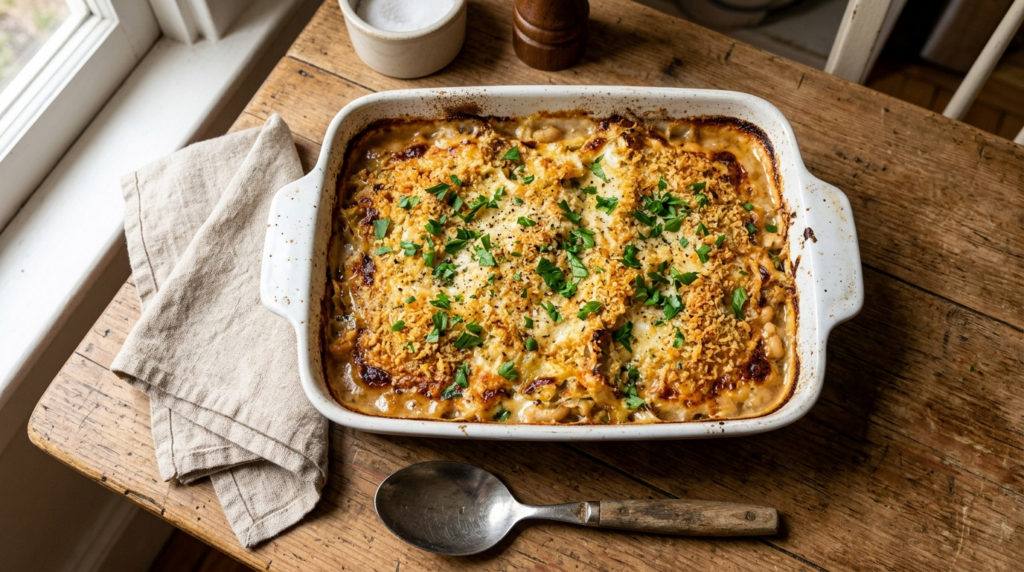
Gratin dishes earn their place in the weekly rotation because they convert humble, affordable ingredients into something genuinely satisfying. Cabbage is easy to overlook as a main event, but when it is slowly braised until tender and sweet, it holds its own against richer vegetables. Paired with cannellini beans for protein and body, then blanketed in a simple cream sauce and finished with a cheesy, crispy topping, cabbage becomes the centerpiece of a dish worth repeating.
This cabbage white bean gratin is straightforward enough for a weeknight but sturdy and flavorful enough to serve at a casual dinner table. The steps are split between the stovetop and the oven, so you have time to prepare the topping while the filling simmers. Everything comes together in one baking dish, making cleanup manageable. If you are looking for a meatless main that actually fills people up, or a crowd-pleasing side to roasted pork or chicken, this recipe delivers on both counts.
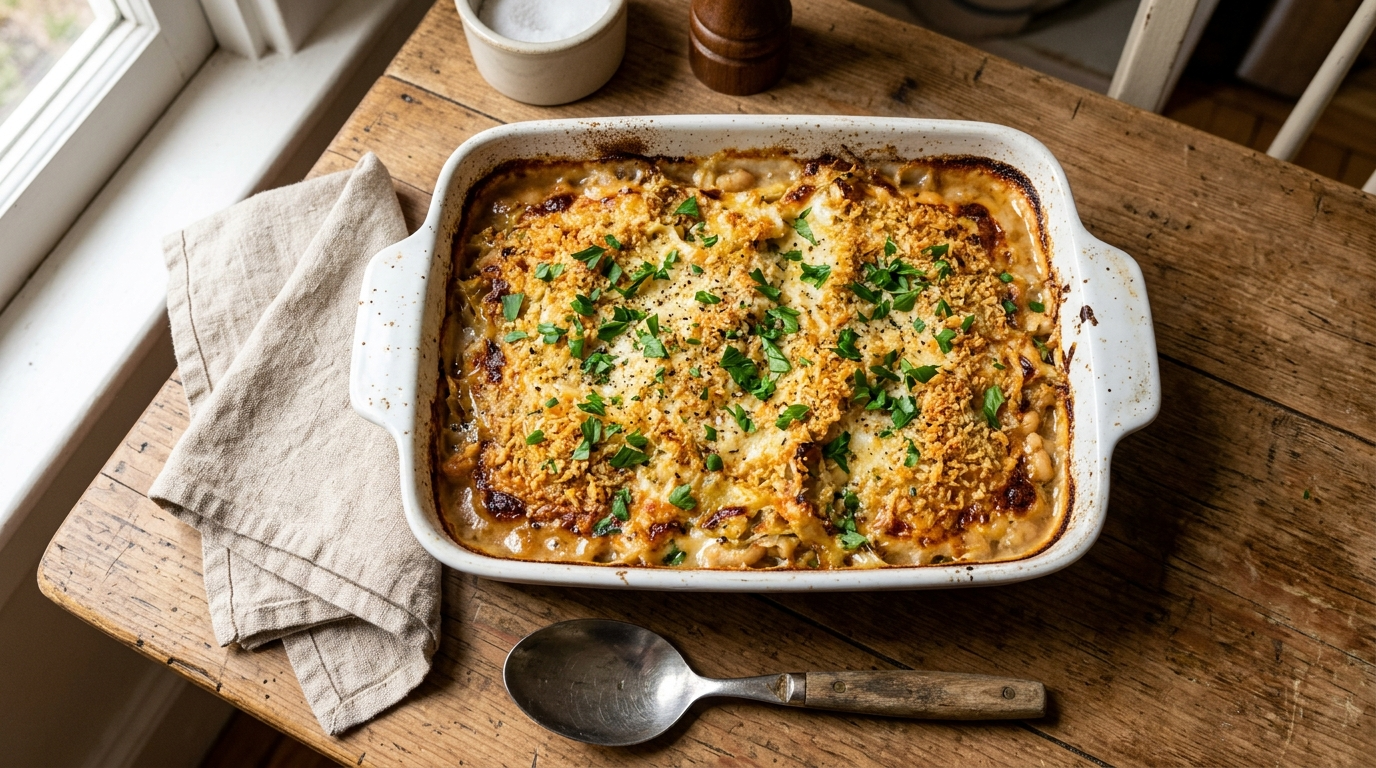
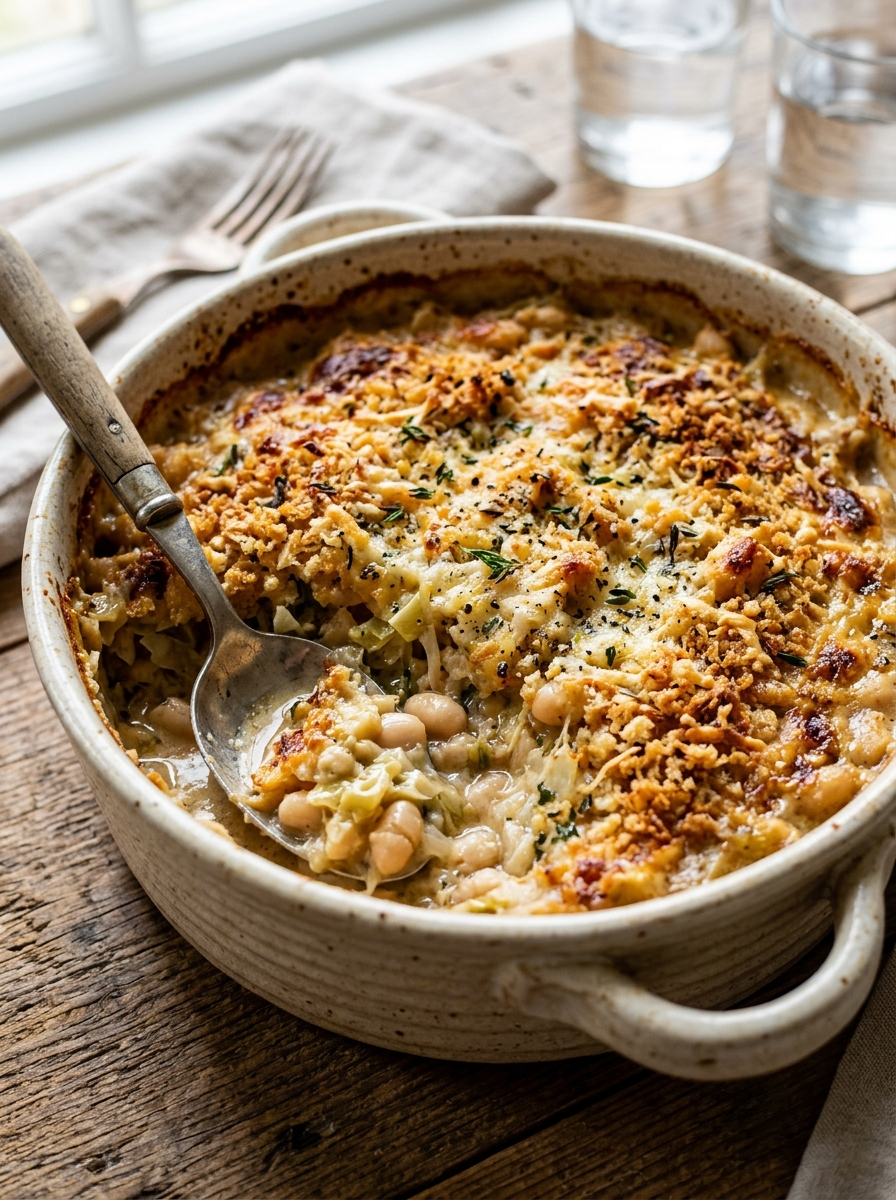
Cabbage and White Bean Gratin – Hearty Baked Comfort Food
Cabbage and white bean gratin combines braised green cabbage and creamy cannellini beans in a savory cream sauce, topped with a crispy Gruyère and breadcrumb crust. It bakes into a golden, bubbling dish that works as a hearty vegetarian main or a substantial side.
Prep: 25 minutes | Cook: 60 minutes | Servings: 6
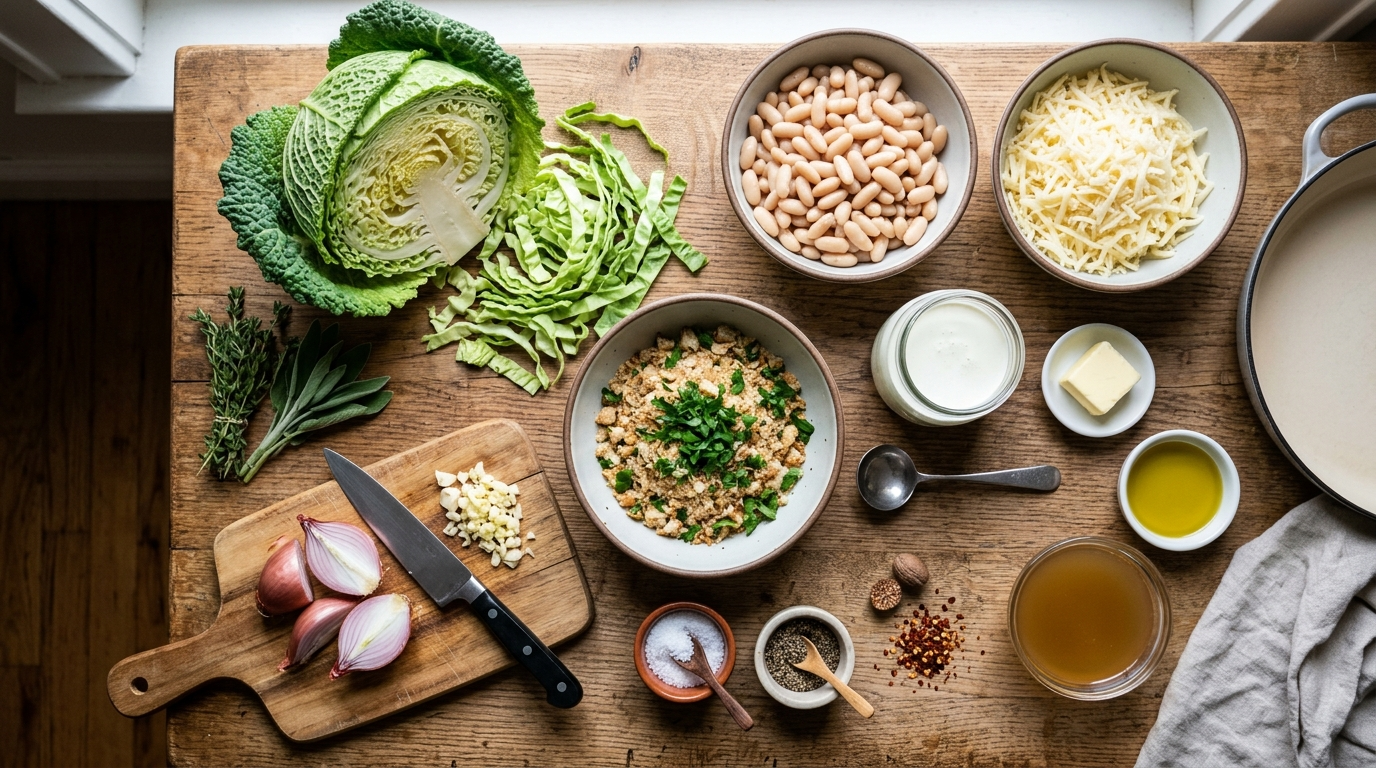
Ingredients
- 2 tablespoons unsalted butter Divided: 1 tablespoon for sautéing vegetables, 1 tablespoon for the sauce
- 1 tablespoon olive oil Combined with butter for sautéing to raise the smoke point
- 1 medium yellow onion Diced into roughly 1/2-inch pieces, about 1 cup
- 4 cloves garlic Minced; about 4 teaspoons
- 1 small head green cabbage About 2 pounds; core removed, leaves shredded into roughly 1/2-inch ribbons, yielding approximately 8 to 9 cups shredded
- 1/2 teaspoon caraway seeds Optional but traditional; lightly crush before adding for more aroma
- 1/2 teaspoon dried thyme Or 1 teaspoon fresh thyme leaves
- 1/4 teaspoon crushed red pepper flakes Optional for mild heat; omit for a milder dish
- 1/2 cup dry white wine Such as Sauvignon Blanc or Pinot Grigio; substitute with low-sodium chicken or vegetable broth if preferred
- 2 cans (15 ounces each) cannellini beans Drained and rinsed thoroughly; about 3 cups total
- 1 teaspoon kosher salt Divided; adjust throughout cooking to taste; use 3/4 teaspoon if using table salt
- 1/2 teaspoon freshly ground black pepper Divided between filling and sauce
- 1 tablespoon all-purpose flour For thickening the cream sauce
- 1 cup whole milk Warmed slightly before adding helps prevent lumps; 2% milk works but produces a slightly thinner sauce
- 1/2 cup heavy cream Adds richness to the sauce; half-and-half can substitute for a lighter result
- 1 teaspoon Dijon mustard Adds a subtle sharpness that balances the richness of the cream
- 1/4 teaspoon freshly grated nutmeg Classic in cream sauces; use a microplane for best results
- 1 cup Gruyère cheese Finely grated; divided: 1/2 cup stirred into the sauce, 1/2 cup for the topping; Comté or aged Swiss can substitute
- 1/2 cup panko breadcrumbs Panko produces a crispier topping than regular breadcrumbs
- 2 tablespoons finely grated Parmesan cheese Mixed into the topping with panko for extra browning and savory flavor
- 1 tablespoon olive oil Drizzled over the breadcrumb topping before baking to encourage even browning
- 2 tablespoons flat-leaf parsley Chopped fresh; for garnish after baking
Instructions
- Preheat the oven to 375°F (190°C). Position a rack in the center of the oven. Lightly butter or spray a 2-quart or 3-quart baking dish and set it aside.
- Remove the outer leaves of the cabbage if wilted or damaged. Cut the head into quarters, remove the core from each quarter, then slice the cabbage crosswise into ribbons approximately 1/2-inch wide. You should have 8 to 9 cups of shredded cabbage. Set aside.
- Drain and rinse the cannellini beans in a colander under cold running water. Shake off excess water and set aside.
- In a large skillet or Dutch oven, heat 1 tablespoon of butter and 1 tablespoon of olive oil over medium heat until the butter is melted and the foam subsides, about 1 to 2 minutes.
- Add the diced onion and cook, stirring occasionally, until softened and translucent, about 5 to 6 minutes. Do not rush this step; properly softened onion builds sweetness in the base.
- Add the minced garlic, caraway seeds (if using), dried thyme, and crushed red pepper flakes (if using). Stir and cook for 1 minute until fragrant.
- Add the shredded cabbage to the skillet in two or three additions, stirring each addition in before adding the next, as the cabbage will be voluminous at first. Season with 1/2 teaspoon kosher salt and 1/4 teaspoon black pepper.
- Pour in the white wine. Stir to deglaze the pan, scraping up any browned bits from the bottom. Increase the heat to medium-high and cook until the wine has largely evaporated, about 2 to 3 minutes.
- Reduce the heat to medium-low, cover the skillet, and braise the cabbage for 15 to 18 minutes, stirring every 5 minutes, until the cabbage is tender and wilted but not mushy. It should collapse significantly in volume. Remove from heat.
- While the cabbage braises, make the cream sauce. In a medium saucepan over medium heat, melt the remaining 1 tablespoon of butter. Whisk in the flour and cook, whisking constantly, for 1 minute to cook out the raw flour taste.
- Slowly pour in the warmed milk in a steady stream while whisking continuously to prevent lumps. Add the heavy cream and continue whisking. Bring the sauce to a gentle simmer over medium heat, whisking frequently, until it thickens enough to coat the back of a spoon, about 3 to 5 minutes.
- Remove the sauce from heat. Whisk in the Dijon mustard, nutmeg, 1/2 cup of the grated Gruyère, 1/4 teaspoon kosher salt, and 1/4 teaspoon black pepper. Stir until the cheese is fully melted and the sauce is smooth.
- Add the drained cannellini beans to the braised cabbage in the skillet and stir gently to combine. Taste the filling and adjust salt and pepper if needed.
- Pour the cream sauce over the cabbage and bean mixture. Stir gently to coat everything evenly.
- Transfer the filling to the prepared baking dish and spread it into an even layer.
- In a small bowl, combine the panko breadcrumbs, Parmesan cheese, and remaining 1/2 cup grated Gruyère. Drizzle 1 tablespoon of olive oil over the mixture and toss with a fork until the crumbs are evenly moistened.
- Scatter the breadcrumb topping evenly over the surface of the filling, covering it completely.
- Cover the baking dish loosely with aluminum foil and bake at 375°F for 20 minutes to heat the filling through.
- Remove the foil and continue baking for an additional 15 to 20 minutes, until the topping is deep golden brown and the sauce is visibly bubbling around the edges.
- Use an instant-read thermometer inserted into the center of the gratin to confirm the internal temperature has reached at least 165°F before removing from the oven.
- Remove the gratin from the oven and let it rest for 10 minutes before serving. This allows the sauce to set slightly so it portions cleanly.
- Garnish with chopped fresh parsley just before serving.
The gratin technique originated in French cuisine, most closely associated with the Dauphiné region, where the word referred to the crust formed when a dish is browned under heat. The term gratin comes from the French verb gratter, meaning to scrape or grate, referencing the grated cheese or breadcrumbs applied to the surface. Gratins spread across European home cooking because the method works with almost any vegetable, potato, or legume that benefits from gentle baking and a crisped topping. Cabbage has long been a staple of peasant and working-class cuisine across France, Germany, and Eastern Europe, prized for its low cost, long storage life, and adaptability. White beans, particularly cannellini, have similarly deep roots in French and Italian country cooking as an affordable, filling protein source. Combining the two in a gratin format reflects the broader tradition of French farmhouse cooking, which prizes economy, seasonal produce, and techniques that extract maximum flavor from inexpensive ingredients.
Practical Tips
- Shred the cabbage no thicker than 1/2 inch so it braises to tenderness within the allotted time. Very thick pieces may remain tough.
- Do not skip the braising step and go straight to baking. Raw or barely wilted cabbage will not cook through fully in the oven and will release too much water into the sauce.
- Warm the milk before adding it to the roux. Cold milk added to a hot roux increases the risk of lumps and can cause the sauce to seize briefly before smoothing out.
- If you notice lumps in the cream sauce, whisk vigorously off the heat or pass it through a fine mesh strainer before combining with the filling.
- For a deeper golden topping without over-baking the filling, place the dish under the broiler on the center rack for 1 to 2 minutes at the very end. Watch it closely; panko browns quickly under a broiler.
- Gruyère melts smoothly and has the nutty flavor that works best in this dish. Buy a block and grate it yourself rather than using pre-shredded cheese, which often contains anti-caking agents that affect melting.
- If the cabbage releases a lot of liquid during braising, remove the lid for the last 5 minutes to allow excess moisture to evaporate before combining with the sauce. Too much liquid will thin the finished gratin.
- Leftovers should be portioned into shallow containers and refrigerated within 2 hours of cooking, at 40°F or below, and consumed within 3 to 4 days. Freeze extra portions for longer storage. Reheat individual servings to an internal temperature of 165°F before eating.
Large oven-safe skillet or Dutch oven (12-inch): Used to braise the cabbage on the stovetop and can transfer directly to the oven if oven-safe; otherwise the filling transfers to a baking dish
2-quart or 3-quart baking dish: Holds the full volume of filling and topping for even baking and browning
Medium saucepan: Used to make the cream sauce separately before combining with the cabbage and beans
Whisk: Essential for making a smooth, lump-free cream sauce
Sharp chef's knife and cutting board: Needed for shredding the cabbage and dicing the onion and garlic
Colander or fine mesh strainer: For draining and rinsing the canned white beans
Measuring cups and spoons: Ensures accurate quantities for the sauce and topping
Wooden spoon or silicone spatula: For stirring the cabbage during braising without damaging a nonstick surface
Instant-read thermometer: Confirms the internal temperature of the gratin reaches a safe and fully heated-through temperature before serving
Aluminum foil: Used to tent the gratin during the first phase of baking to prevent the topping from over-browning before the filling is hot
Smoky Bacon and Cabbage White Bean Gratin: Render 4 ounces of diced bacon in the skillet before adding the onion. Remove the bacon with a slotted spoon and drain off all but 1 tablespoon of the fat. Use that fat in place of the butter and oil for sautéing the onion. Stir the cooked bacon into the filling before transferring to the baking dish. The smokiness of the bacon pairs naturally with the sweetness of braised cabbage.
Vegan Cabbage and White Bean Gratin: Replace the butter with a neutral plant-based butter. Substitute whole milk and heavy cream with full-fat unsweetened oat milk or a 1:1 combination of oat milk and full-fat coconut milk. Use vegan Parmesan or nutritional yeast in the topping. Omit the Gruyère or use a melting-style vegan cheese. The sauce will be slightly less rich but the dish remains filling and flavorful.
Savoy Cabbage and Navy Bean Gratin: Swap green cabbage for Savoy cabbage, which has a more delicate, slightly crinkled leaf that wilts more quickly and has a milder flavor. Use navy beans in place of cannellini for a slightly smaller bean with a creamier texture. Reduce the braising time by about 5 minutes since Savoy cabbage softens faster.
Roasted Garlic and White Bean Gratin: Roast an entire head of garlic by slicing off the top, drizzling with olive oil, wrapping in foil, and baking at 400°F for 40 to 45 minutes until the cloves are completely soft and golden. Squeeze the roasted cloves into the cream sauce in place of the raw minced garlic. This produces a much sweeter, more mellow garlic flavor throughout the gratin.
Herb-Forward Spring Gratin with Great Northern Beans: Add 2 tablespoons of chopped fresh tarragon and 1 tablespoon of fresh chives to the cream sauce along with the Dijon mustard. Substitute Great Northern beans for cannellini. Add 1 cup of frozen peas, thawed, to the filling just before transferring to the baking dish. The herbs and peas brighten the flavor and make this variation feel suited to spring menus.
Can I assemble the cabbage white bean gratin ahead of time?
Yes. You can fully assemble the gratin through the breadcrumb topping step, cover it tightly with plastic wrap or foil, and refrigerate it for up to 24 hours before baking. When ready to bake, remove it from the refrigerator and let it sit at room temperature for 20 to 30 minutes while the oven preheats. Add 10 to 15 minutes to the covered baking time since the dish will be starting from cold. Confirm the center reaches 165°F with an instant-read thermometer before serving.
What can I substitute for Gruyère if I cannot find it?
Comté is the closest substitute and behaves almost identically in melting and flavor. Aged Swiss cheese works well and is widely available. Fontina melts beautifully but has a milder flavor. Raclette is another good option. Avoid very young, rubbery Swiss cheeses, as they do not melt as smoothly into the sauce.
Can I use dried white beans instead of canned?
Yes, but they must be fully cooked before using in this recipe. Sort and rinse 1 cup of dried cannellini or Great Northern beans, soak them overnight in cold water, then drain and simmer in fresh water for 60 to 90 minutes until completely tender. Drain and use in place of the canned beans. Do not add undercooked beans to the gratin, as the oven baking time is not sufficient to cook dried beans through.
My gratin looks watery after baking. What went wrong?
This usually means the cabbage was not braised long enough or still held too much moisture when it was combined with the sauce. Make sure the cabbage is fully wilted and tender before proceeding, and if there is visible liquid in the skillet after braising, cook uncovered for a few additional minutes to evaporate it. Rinsed beans also carry residual water, so drain them thoroughly. Using 2% milk instead of whole milk and skipping the heavy cream can also produce a thinner sauce.
Is this dish vegetarian or vegan?
As written, this recipe is vegetarian but not vegan, since it contains butter, milk, cream, and cheese. See the vegan variation in the variations section for guidance on adapting it to be fully plant-based.
What proteins or sides pair well with this gratin as a main course?
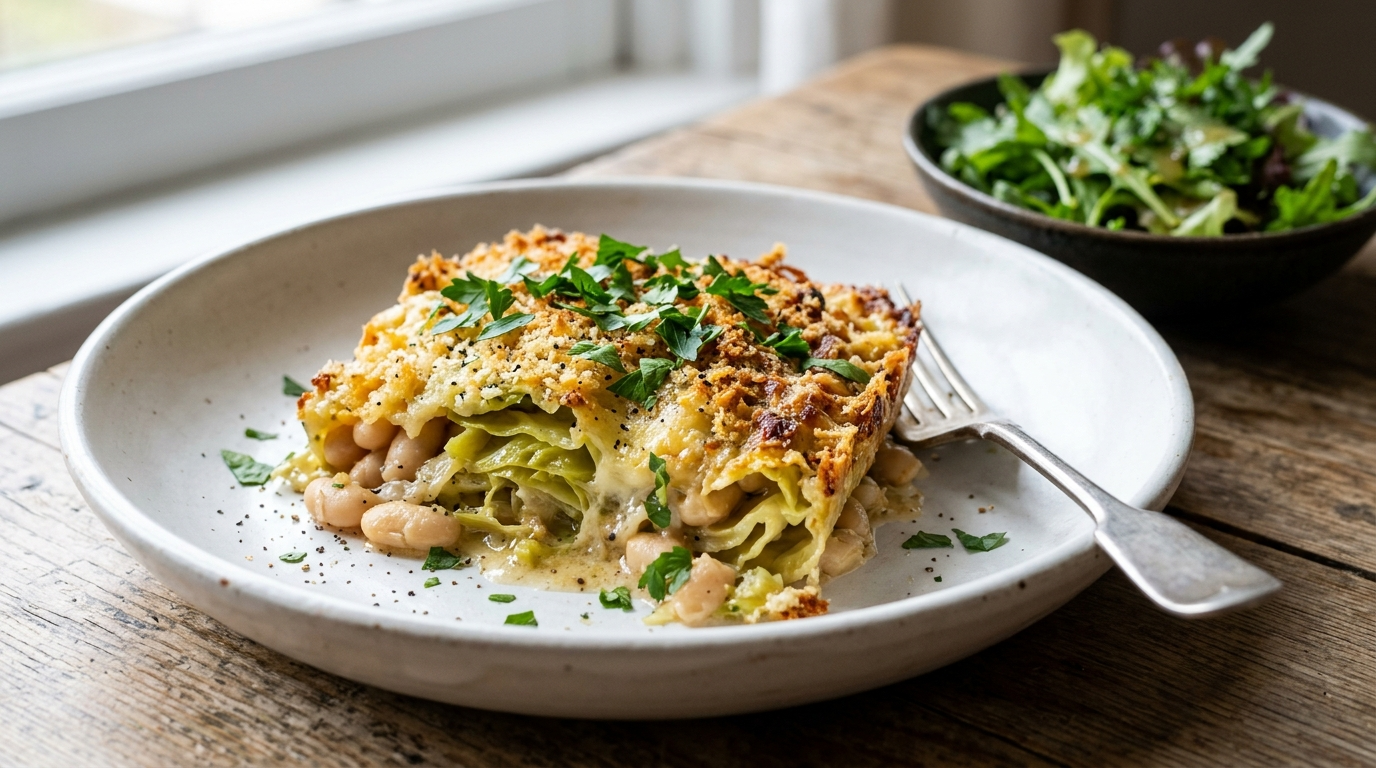
A simple green salad with a sharp vinaigrette cuts through the richness of the cream sauce effectively. Crusty bread is useful for scooping up the sauce. If serving alongside a protein, roasted chicken thighs, braised sausages, or a simple pork tenderloin all complement the flavors without competing with them. For a fully vegetarian meal, the gratin is filling enough on its own with a salad.
How do I store and reheat leftovers safely?
Divide leftovers into shallow airtight containers within 2 hours of cooking and refrigerate at 40°F or below. Use within 3 to 4 days. To reheat, place individual portions in an oven-safe dish, cover with foil, and bake at 350°F until the internal temperature reaches 165°F, typically 15 to 20 minutes depending on portion size. You can also reheat individual portions in a microwave, checking with a thermometer to confirm 165°F is reached before eating. For longer storage, freeze portions in airtight containers; thaw in the refrigerator overnight before reheating.
Can I use red cabbage instead of green?
Red cabbage will work from a texture standpoint, but it will bleed its deep purple pigment into the cream sauce, turning the finished dish an unappetizing grayish-purple color. It also has a slightly firmer texture and more pronounced flavor than green cabbage. Savoy cabbage is a better substitute if you want to change the cabbage variety, as it stays close to the intended flavor and appearance.